Agentic AI changes the economics of SaaS because its costs are variable and consumption-driven, not fixed per user. Two architectural patterns—tiered agent hierarchies and hybrid local/cloud model routing—give product managers and architects direct levers over those costs. The first attacks redundant context processing; the second stops routing every request to an expensive large model. Both patterns also push pricing strategy away from per-seat models toward consumption- and outcome-based structures.
Understanding Agentic AI Cost Drivers in SaaS
The core problem is that agentic systems consume paid model capacity on every step of a workflow. AWS's guidance for independent software vendors notes that consumption-based costs in agentic AI are "less predictable and often higher than traditional SaaS," because model inference costs, data processing volumes, and autonomous task execution create variable expenses that fixed per-user pricing cannot absorb.
Cockroach Labs, in an analysis of agent costs at scale by Quentin Packard, identifies the largest hidden driver as the "re-sent context problem": the repeated transmission of system prompts, tool definitions, skills, instructions, and state history across multiple model calls within the same workflow. In practice, teams often pay the model to reprocess information it has already seen. Unmanaged, these costs do more than inflate cloud and API spend—they make product margins harder to forecast, make AI ROI harder to prove, and slow the path from experimental agents to production systems that can scale economically.
A second driver is inference routing itself. AWS engineers describe a common failure mode: every request, whether a routine status check or a complex analysis, gets routed to a single large, expensive model. This one-size-fits-all approach drives up API costs, introduces unpredictable latency, and removes the possibility of offline operation.
Tiered Agent Architectures for Cost Control
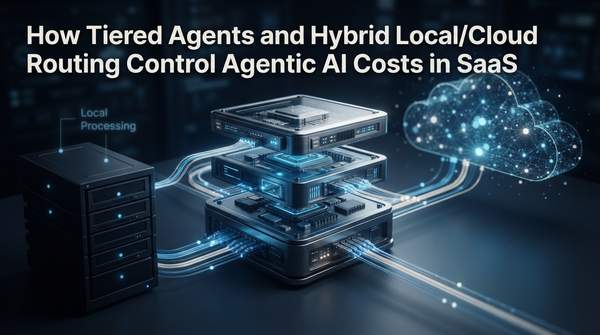
The tiered, or hierarchical, agent model addresses the re-sent context problem structurally rather than by tuning prompts. In the pattern Cockroach Labs describes, a coordinator agent holds a small set of high-level tools and discovers which specialized sub-agents to activate based on the task. Each sub-agent then operates with its own focused schema set, so no agent sees more context than its scope requires. Tool schema overhead drops proportionally at every layer.
The mechanism matters because it changes what the provider bills for. If a monolithic agent must carry every tool definition and the full state history into each model call, token volume compounds with every step. Delegating to sub-agents that receive only task-relevant context removes that redundancy. Cockroach Labs pairs this with just-in-time retrieval—pulling context only when the agent signals it needs it, not upfront—which keeps working context under 8K tokens and, in their reporting, consistently improves accuracy.
The same structure creates a cleaner governance boundary: each agent can be limited to the tools, data, and actions its role requires, which matters for SaaS platforms serving customers with compliance expectations.
Hybrid Local/Cloud Routing for Efficient Inference
The second pattern targets inference cost and latency. AWS's Adaptive Agentic Intelligence Framework (AAIF), built with Strands Agents, routes routine requests to local small language models (SLMs) and reserves cloud models on Amazon Bedrock for complex analysis. The stated result is reduced API costs while maintaining low latency for routine operations, since simple queries no longer require a full network round-trip to a cloud-hosted LLM.
This is adaptive routing based on task complexity: a request is classified, then directed to the cheapest model capable of handling it. The pattern is most effective where a large share of workload is routine. AWS highlights IoT monitoring as the canonical case—many routine checks that a local SLM can resolve, with cloud capacity reserved for high-value analysis. AWS suggests this pattern extends to other sectors, such as healthcare, where patient monitoring could run locally with diagnosis support routed to cloud models. Similarly, financial services firms might process transactions on-premises while reserving cloud capacity for risk analysis. Manufacturing teams could also implement quality control vision models at the edge, sending optimization requests to the cloud.
Comparing Agentic AI Architectural Patterns for Cost Management
The two patterns are complementary rather than competing: each addresses a different cost driver through a distinct mechanism. The table below compares them across the dimensions a product team would weigh when choosing where to invest.
| Architectural Pattern | Primary Cost Driver Addressed | Mechanism | Typical Use Case |
|---|---|---|---|
| Tiered/Hierarchical Agent Model | The re-sent context problem—agents repeatedly paying to reprocess the same prompts, tool definitions, and state history, which Cockroach Labs identifies as the single biggest invisible cost in agentic systems. | A coordinator agent delegates tasks to specialized sub-agents, each with its own focused schema set; sub-agents receive only the context relevant to their task, so tool schema overhead drops at every layer. | Complex multi-step workflows where a monolithic agent would carry large tool sets and state history into every call; also where per-role governance boundaries are needed. |
| Hybrid Local/Cloud Model | High inference cost and unpredictable latency from routing every request—routine or complex—to a single expensive cloud LLM. | Adaptive routing sends simple, routine requests to local SLMs and complex, analytical requests to larger cloud-based models, optimizing resource allocation by task complexity. | Mixed workloads with many routine operations, such as IoT monitoring, where local models handle routine checks and cloud capacity is reserved for high-value analysis. |
Read together, the comparison shows the decision boundary: if your cost problem is compounding context across a workflow, tiering is the structural fix; if it is paying premium-model prices for trivial requests, routing is. Many production systems will need both.
Architectural Choices and SaaS Business Models
These technical mechanisms connect directly to pricing strategy. AWS argues that traditional per-seat pricing "fails to reflect either the costs incurred or the value delivered" once agentic AI enters the product, because inference, data processing, and autonomous execution produce variable expenses that do not align with fixed per-user structures. The architectural patterns above are what make those variables manageable enough to price against.
Cockroach Labs frames the divide in organizational terms: teams that treat agent costs as an engineering problem spend 60 to 70% less for equivalent output than teams that treat them as a subscription line item, in their assessment. Their prescription is to measure outcomes rather than tokens—"The token is not the unit of value. The task outcome is"—and build the measurement system around outcomes so token costs follow. SaM Solutions' strategy guidance for SaaS transformation points the same direction, toward "new value-based models," while cautioning teams to start small, prove ROI, keep humans in control where risk is high, and scale what works.
For product managers, the implication is that architecture and pricing cannot be designed in isolation. A tiered or hybrid system produces a cost profile that is predictable enough to support consumption- or outcome-based pricing; a monolithic, single-model system does not.
Strategic Decision: Architecting for Agentic AI Cost Efficiency
SaaS product managers and architects should prioritize architectural patterns like tiered agents or hybrid local/cloud routing to proactively manage the variable and often high operational costs of agentic AI systems. The choice between them follows the cost driver: tiering when re-sent context dominates, routing when inference spend on routine requests dominates, and both when workflows are long and workloads are mixed.
The measurable indicator of success is a reduction in average cost-per-outcome for agent-driven tasks, or a more predictable alignment between agent usage and revenue generation. That is the metric Cockroach Labs' outcome-first measurement approach is built to produce, and it is the number to watch as you move from experimental agents to a production architecture your margins can carry.
Sources
- Why SaaS Companies Must Transform Their Business Models for the Agentic AI Era — Amazon Web Services, Inc.
- Managing Agentic AI Costs at Scale — Cockroachlabs
- Adaptive agentic intelligence framework using Strands Agents — Amazon Web Services
- How Agentic AI Transforms SaaS Companies: Architecture, Use Cases, and Strategy — SaM Solutions