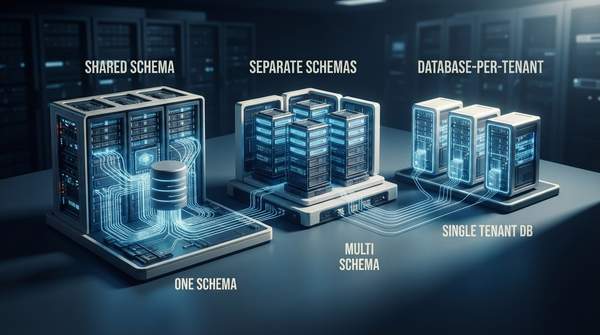
For most SaaS teams, the answer comes down to one trade-off: the more isolation you promise a tenant, the more databases you end up managing and paying for. Shared schema keeps every tenant in one set of tables and is the cheapest and simplest to run; database-per-tenant gives each customer its own database and the strongest isolation, at the highest operational cost; separate schemas sit in between. Here is how the three patterns compare, and how to pick.
Understanding Multi-Tenant Database Architectures
Multi-tenancy means multiple customers share one application and its underlying data infrastructure, so the architecture has to guarantee that one tenant can never see another's records. In my experience, this is the decision that quietly shapes your cost structure, your compliance story, and your engineering roadmap for years, so it deserves more than a default choice.
There are three established ways to implement tenancy at the database layer. The first is a shared schema: one database, one set of tables, with a tenant identifier distinguishing each customer's rows. The second is separate schemas: still one database instance, but each tenant gets its own schema within it. The third is database-per-tenant: every customer gets a dedicated database. As one practitioner comparison of these patterns puts it, the choice depends on balancing customization, compliance, and operational complexity.
Frontegg's guide to multi-tenant architecture notes that this is the pattern behind most early-stage B2B SaaS products: one Postgres database with a tenant_id column—or a per-tenant schema—enforced on every query. In other words, most teams start shared and only move toward stronger isolation when a customer, contract, or regulator forces the issue.
Shared Schema: Cost-Efficiency and Simplicity
In the shared schema pattern, all tenants live in the same tables, and isolation is enforced by a tenant ID column on every row, optionally backed by Row-Level Security (RLS) policies in the database. Clerk's architectural guide describes these as the standard techniques for enforcing isolation in a shared system: a tenant ID column, RLS policies, or segregation at the schema or database level. When implemented properly, each tenant's records remain invisible to the others.
The appeal is straightforward. Frontegg calls the shared schema with a tenant ID column the cheapest option to run and the easiest to scale to thousands of small tenants. Because you manage a single database instance, operational overhead stays low no matter how many tenants sign up, which is why this pattern dominates early-stage B2B SaaS.
The cost of that efficiency is responsibility. Isolation is entirely an application-code concern unless you pair it with database-level row-level security, as Frontegg cautions—every query must be tenant-aware, and one missed filter is a data-leak incident. Clerk adds another limitation: tenants sharing one system cannot demand unique customizations that affect only their instance without impacting others. Shared schema is optimal for simplicity and cost, but it requires robust enforcement.
Separate Schemas: A Balanced Approach
The middle pattern keeps one shared database instance but gives each tenant a distinct schema—a separate namespace for that tenant's tables. This provides better data isolation than a shared schema because tenant data is segregated at the schema level rather than mixed in the same tables, while still avoiding the overhead of running many separate databases.
That makes it a genuine middle ground. A comparison of multi-tenancy database patterns describes separate schemas as sitting between shared schema and database-per-tenant, with trade-offs in both performance and management complexity: simpler to manage than a fleet of per-tenant databases, but more involved than a single shared schema, since management now involves handling multiple schemas within one database instance.
Separate schemas also unlock moderate customization flexibility. Because each tenant has its own schema, some schema-level modifications per tenant become possible—though this flexibility is balanced by the need to keep the underlying database structure consistent enough to operate as one system. For B2B applications with a moderate tenant count and per-customer variation, that balance is often exactly what's needed.
Database-per-Tenant: Maximum Isolation and Security
The most isolated pattern gives every tenant a dedicated database instance. Nothing is shared at the storage layer, so a tenant's data is physically separated from every other tenant's. The same patterns comparison is blunt about the trade: database-per-tenant is preferred for maximum isolation, but it is the most expensive and operationally complex option, making it unsuitable for applications with a large number of tenants.
Where it earns its keep is compliance and customization. The comparison concludes that the pattern is best suited to scenarios where data isolation, regulatory compliance, and tenant-specific customization are critical, providing the highest level of security and isolation for industries with stringent compliance requirements. Frontegg makes the same point from the customer side: regulated industries such as healthcare and finance often require this level of isolation contractually, even when the application code and deployment pipeline are otherwise fully multi-tenant.
Clerk's guidance adds the commercial angle: big enterprise clients—especially in finance, healthcare, and government—often have strict security and compliance requirements, and may even require an isolated environment by policy. A dedicated database or instance for that client can be what it takes to close those deals, and it can also accommodate custom features or integrations without affecting other customers. The operational price is real: monitoring, connection pooling, and sharding strategies all have to be applied across every tenant database.
Multi-Tenant Database Architecture Comparison
The table below evaluates the three patterns against the five criteria that matter most in this decision. Use it to locate your own requirements quickly: find the row that matches your hardest constraint—compliance, tenant count, or budget—and read across.
| Requirement | Shared Schema | Separate Schemas | Database-per-Tenant |
|---|---|---|---|
| Data Isolation | Lowest; relies on tenant ID columns or Row-Level Security in one shared set of tables | Moderate; tenants segregated into distinct schemas within a shared database | Highest; each tenant has a dedicated database instance |
| Scalability | Easiest to scale to thousands of small tenants on a single instance | — | Unsuitable for a large number of tenants due to per-database overhead |
| Operational Complexity | Lowest; one database instance to manage | Middle ground; multiple schemas within one instance | Highest; every tenant database must be managed, monitored, and migrated |
| Cost Efficiency | Highest; cheapest to run | Moderate | Most expensive option |
| Customization Flexibility | Lowest; shared-structure changes affect all tenants | Moderate; some schema-level modifications per tenant, balanced against consistency | Highest; tenant-specific customization is a core strength |
Read as a whole, the table yields a clear pattern: every step from shared schema toward database-per-tenant buys isolation and customization and pays for it in cost and operational complexity. If your priority is maximum security and compliance, the right-hand column is your answer; if it is cost-efficiency across many tenants, the left-hand column is.
Choosing the Right Architecture: A Decision Framework
Turn the comparison into a decision with three questions. First, does any significant customer or regulator contractually require dedicated isolation? Frontegg reports that regulated industries—healthcare and finance chief among them—often require that isolation contractually, and Clerk notes that enterprise clients in finance, healthcare, and government may require an isolated environment by policy. If yes, database-per-tenant (or a hybrid dedicated instance for those specific clients) is likely the only architecture that closes the deal.
Second, how many tenants do you expect, and how much revenue does each carry? Shared schema is the cheapest to run and the easiest to scale to thousands of small tenants, which is why it is the default for early-stage B2B SaaS. Database-per-tenant, by contrast, is unsuitable for applications with a large number of tenants. Third, do customers need per-tenant customization? If a few enterprise accounts demand custom features or integrations, separate schemas or a dedicated database for those accounts can accommodate them without affecting other customers.
Two caveats apply to any choice. This is a comparison of architectural patterns, not of specific database products or vendors, and it deliberately excludes performance benchmarks, which depend heavily on your workload. And the patterns are not mutually exclusive over time: teams commonly start shared and move specific tenants to stronger isolation as contracts require it.
Selecting Your Multi-Tenant Database Architecture
The optimal multi-tenant database architecture depends on a careful balance of data isolation requirements, expected tenant scale, operational budget, and customization needs. Prioritize Database-per-Tenant for strict compliance and enterprise clients, Shared Schema for cost-sensitive applications with many tenants, and Separate Schemas for a balanced approach.
Whatever you choose, define success in measurable terms: the chosen architecture's ability to meet compliance audits, manage operational costs per tenant, and scale effectively with tenant growth without compromising data isolation. If your first enterprise security questionnaire or compliance audit arrives and your architecture cannot answer it, that is the concrete signal to revisit the decision—before the next large customer asks.