
Saas Architecture
6 articles

Translating Zero Trust Principles into SaaS Architecture: A Principle-to-Pattern Decision Framework
Zero Trust in cloud-native SaaS is an architectural discipline requiring explicit, continuous verification for all access decisions. This article provides a decision framework mapping Zero Trust principles to concrete SaaS architectural patterns and common implementation challenges.

How Homomorphic Encryption Enables Multi-Party Computation: Architecture, Overhead, and the SaaS Decision
Homomorphic encryption (HE) provides a cryptographic foundation for secure multi-party computation (MPC), enabling joint evaluation of functions on private inputs without revealing them. While offering non-interactive computation attractive for SaaS, it incurs significant computational overhead, necessitating careful trade-off analysis.

Matching Tenant Isolation and Resilience Patterns to Your SaaS Business Tiers
Resilient multi-tenant SaaS architectures are not built from a single pattern but require a tiered approach. The optimal combination of isolation and resilience strategies depends on your pricing strategy and engineering constraints, directly mapping isolation levels to price points.

Matching SaaS Business Requirements to Multi-Cloud and Hybrid-Cloud Architectural Patterns
Choosing between multi-cloud and hybrid cloud for SaaS involves mapping specific business drivers like data residency, resilience, or latency to documented architectural patterns. This article outlines the decision framework, key patterns, and trade-offs in data consistency and network latency for effective SaaS deployment.

Comparing AI Agent Architectural Patterns for SaaS Platforms
Integrating AI agents into SaaS platforms requires careful architectural decisions. This article compares key patterns like Single-Agent, Orchestrator-Worker, and Event-Driven architectures, detailing their trade-offs for scalability, complexity, and performance to guide your selection.
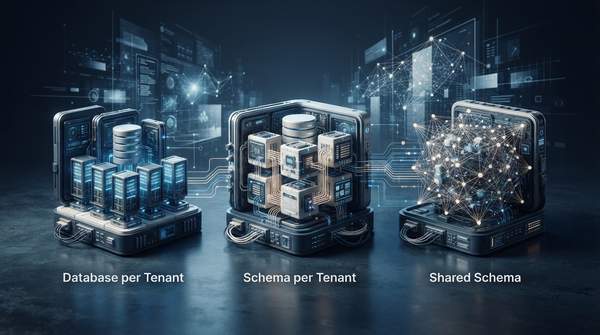
Comparing Multi-Tenancy Database Patterns for SaaS Applications
SaaS architects must choose between database-per-tenant, schema-per-tenant, and shared-schema multi-tenancy database patterns. This article compares their trade-offs in isolation, cost, and complexity to guide optimal selection for SaaS applications.