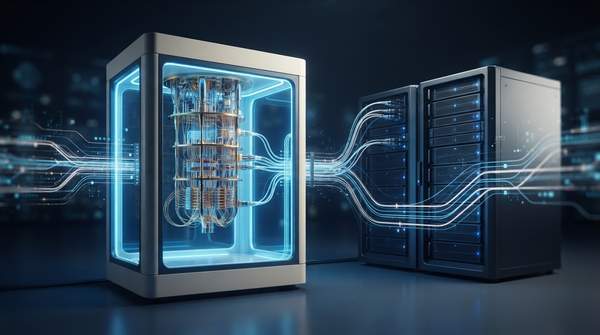
Hybrid quantum-classical computing is the dominant paradigm because today's quantum processors cannot stand alone: they excel at narrow computational tasks while classical machines handle everything else. The practical question for engineers is not whether to combine the two, but how to structure the combination. This article explains the fundamental loop that defines the paradigm, introduces a three-layer taxonomy of quantum software patterns, and then works through one documented architectural answer—the Hybrid-Service pattern, illustrated by the QuantumMRI application—before examining the dependability challenges any such system must confront.
The Hybrid Quantum-Classical Paradigm
Hybrid quantum computing is, at its core, an architectural strategy that assigns work according to the strengths of each hardware type. As QuEra Computing explains, classical computers are exceptionally efficient at branching logic, high-speed memory access, and arithmetic, while quantum computers excel at representing states involving complex interference patterns and global entanglement. In the hybrid model, a developer writes a program that runs on a classical host, and when the program hits a mathematical bottleneck requiring quantum acceleration, it sends a specialized instruction to the quantum processing unit.
Most hybrid models rely on an iterative loop in which classical results inform the next quantum circuit configuration, a structure that also minimizes the coherence time demanded from the QPU and reduces the impact of environmental noise. Researchers at Argonne and collaborating institutions, including Martin Suchara and colleagues, argue that this pairing is not merely convenient but necessary: classical supercomputing can aid unreliable quantum processors of intermediate size to solve large problem instances reliably, because large quantum circuits must be broken into smaller sub-circuits evaluated on a quantum processor or a classical simulator. Their conclusion is that hybrid architectures will be necessary to solve large computational problems with near-term quantum hardware.