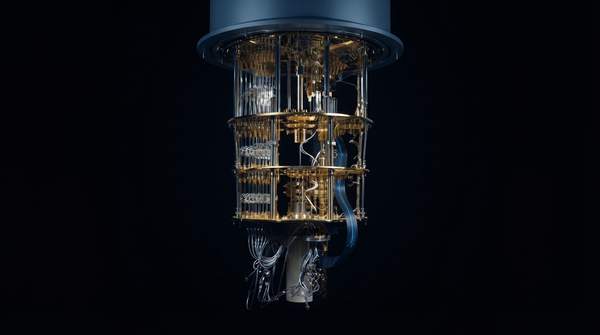
IonQ will deploy its Superion 256 quantum computer at the NVIDIA Accelerated Quantum Research Center (NVAQC), the company announced on September 23, 2026, marking the facility's first on-premise quantum computing deployment. The trapped-ion system will connect directly to an NVIDIA GB200 NVL72 accelerated computing rack through NVIDIA's NVQLink interconnect, with the open-source CUDA-Q platform orchestrating hybrid quantum-classical workloads across the unified machine. Installation is scheduled for 2027, alongside IonQ's first commercial deliveries of the system.
The announcement is notable less for the hardware itself than for where it will sit: inside a facility that IonQ describes as built to advance the integration of quantum processors with state-of-the-art supercomputing hardware. Rather than accessing a quantum computer over the cloud, researchers at the center will work with a QPU physically wired into an NVIDIA GPU rack, a configuration the partners intend to use to study quantum-GPU system design, hybrid software, and applications in finance, materials science and drug discovery.
The Hybrid Architecture: Components of the Integrated System
The deployment's significance rests on how four distinct technologies are designed to function as one machine. The quantum layer is IonQ's Superion 256, the company's sixth-generation trapped-ion QPU, which tackles problems intractable for classical computers. The classical layer is NVIDIA's GB200 NVL72, the company's AI infrastructure for accelerated computing, which handles the classical parts of hybrid quantum-classical workloads. Between them sits NVQLink, an interconnect NVIDIA made publicly available at GTC 2026 through an API called cudaq-realtime, and above all of it runs CUDA-Q, the software platform researchers use to develop and execute hybrid quantum applications.
According to NVIDIA, NVQLink provides the low-latency, high-throughput connections researchers need to perform control tasks like calibration and quantum error correction, and it allows QPU operators to unify quantum and accelerated compute resources. CUDA-Q exposes those capabilities through real-time APIs. The table below maps each named technology to its functional role in the integrated architecture.
The IonQ-NVIDIA Hybrid Quantum-Classical System Explained
| Component | Technology | Role in the Hybrid System |
|---|---|---|
| Quantum subsystem | IonQ Superion 256 | The quantum processing unit — IonQ's sixth-generation trapped-ion QPU — tackles problems intractable for classical computers. |
| Classical subsystem | NVIDIA GB200 NVL72 | NVIDIA's AI infrastructure for accelerated computing; handles the classical parts of hybrid quantum-classical workloads. |
| System interconnect | NVIDIA NVQLink | Provides low-latency, high-throughput connections between the QPU and GPU-accelerated servers for control tasks and data exchange — crucial for tightly-coupled hybrid algorithms and quantum error correction. Made publicly available at GTC 2026. |
| Software platform | NVIDIA CUDA-Q | Orchestrates hybrid quantum-classical algorithms, unifying quantum and accelerated compute resources; uses real-time APIs to leverage NVQLink, allowing researchers to develop and execute hybrid quantum applications. |
Read together, the layers describe a deliberate division of labor: the QPU performs quantum computation, the GB200 rack performs the classical processing that surrounds it, NVQLink moves control signals and data between the two quickly enough for error correction to function, and CUDA-Q lets a single program coordinate the whole. That last point is the practical meaning of "hybrid quantum-classical supercomputing" in this context — not two machines used separately, but one programmable system.
Strategic Rationale: Accelerating Quantum-Classical Co-Design
The partnership's stated purpose is co-design: learning how quantum processors and GPU-accelerated supercomputers should be built, connected and programmed together. IonQ says the NVAQC is designed to address the fundamental challenges of scaling quantum processors into a new class of accelerated quantum supercomputers, and the partners will jointly research quantum-GPU system design and hybrid software alongside the application work.
The tight coupling matters because hybrid algorithms have historically been constrained by the distance between quantum and classical resources. NVQLink's stated purpose — low-latency, high-throughput connections for control tasks such as calibration and quantum error correction, with CUDA-Q unifying quantum and accelerated compute — is what the partners are betting can overcome those latency and data-flow bottlenecks. IonQ Chairman and CEO Niccolo de Masi framed the deployment as "the beginning of an exciting era of hybrid quantum-classical computing," one he said "will be unlocked by multiple generations of Superion systems and NVIDIA's industry-leading AI platforms." He added that IonQ's roadmap to 10,000 qubits and full fault tolerance is accelerating through vertical integration of its SkyWater CMOS foundry.
No performance benchmarks for the integrated system have been released, so the architectural argument rests on design intent rather than measured results. What the announcement does establish is that both companies are investing in the integration problem itself — the plumbing and software that determine whether hybrid algorithms can run as unified workloads rather than as loosely coupled jobs passing data back and forth.
Targeted Research Fields and Potential Impact
The partners have named three application domains: finance, materials science and drug discovery. These are fields where the hybrid model is intended to matter most, because the problems involve both quantum-scale simulation — where a QPU has potential advantages — and heavy classical computation for data processing, optimization and model refinement, which is what the GB200 rack supplies.
For researchers, the practical consequence is access to a unified platform on which hybrid algorithms can be developed and tested against real hardware rather than simulated quantum resources. NVIDIA's own quantum computing materials point to use cases including quantum algorithm optimization, risk modeling, materials science and computational chemistry, consistent with the application areas the partners cite. The center's work is also expected to produce open-source software contributions, per IonQ's announcement, which would extend the deployment's reach beyond the researchers physically present at the facility.
Installation Timeline and Future Outlook
The Superion 256 is scheduled for installation at the NVAQC in 2027, timed with the system's first commercial deliveries. That timing positions the research center as an early, working instance of the architecture IonQ intends to sell commercially — a reference deployment where quantum-GPU integration can be studied before the same configuration reaches customers.
The longer-term question is whether the co-design research produces findings that generalize. IonQ's roadmap contemplates multiple Superion generations and a path toward fault tolerance, while NVIDIA notes that supercomputing centers globally are adopting NVQLink to integrate quantum processors. If the NVAQC deployment demonstrates that tightly coupled hybrid workloads run effectively on this stack, it would strengthen the case for similar integrations elsewhere.
Implications for Quantum Research and Development
Researchers can now leverage a tightly integrated platform to accelerate the development and testing of hybrid quantum-classical algorithms, potentially leading to breakthroughs in complex scientific and industrial problems. The measurable indicators to watch are the successful execution of complex hybrid algorithms in targeted fields like drug discovery and financial modeling, and the release of new open-source software contributions from the research center — outcomes that would show whether the announced architecture delivers on its design intent once the Superion 256 is installed in 2027.
Sources
- IonQ to Advance Quantum Supercomputing by Bringing First QPU to NVIDIA Accelerated Quantum Research Center — Investors
- Quantum Computing Solutions from NVIDIA
- IonQ Selected as First On-Premise QPU Deployment at NVIDIA’s Accelerated Quantum Research Center — Quantum Computing Report
- NVIDIA NVQLink for Quantum Computing