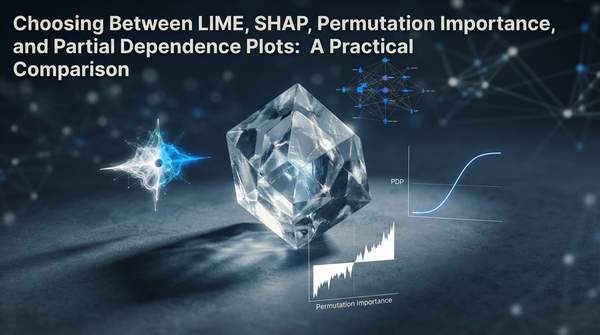
For most enterprise machine learning teams, the right explainability method comes down to one question first: do you need to explain a single prediction, or the model's overall behavior? SHAP is the only one of the four widely used techniques that answers both questions on a common foundation—but that unification carries a computational price in its general-purpose form. LIME is built for individual predictions, while Permutation Importance and Partial Dependence Plots are global tools that rank and visualize how features shape predictions across the whole model. All four are post-hoc, model-agnostic methods, meaning they work on trained models without requiring access to their internal structure. Here is how the trade-offs actually break down.
Choosing Between LIME, SHAP, Permutation Importance, and Partial Dependence Plots: A Practical Comparison
Choosing the right XAI method hinges on whether you need to explain individual predictions or the model's overall behavior. This comparison details LIME, SHAP, Permutation Importance, and Partial Dependence Plots, highlighting their trade-offs in scope, cost, and explanation type.
JA
Jordan Adebayo
November 8, 2026 · 7 min read