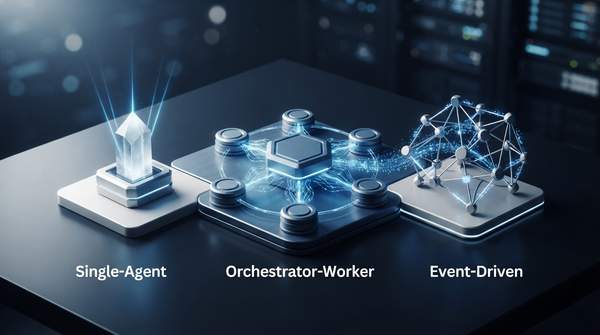
Integrating autonomous AI agents into a Software-as-a-Service (SaaS) platform introduces significant architectural decisions that directly impact scalability, complexity, and performance. Choosing the right pattern is a foundational step for architects and product managers aiming to build robust, maintainable, and effective agentic systems. While a simple, single-agent approach provides a valid starting point, enterprise-grade requirements for complex, high-volume tasks often necessitate more sophisticated multi-agent designs, such as the Orchestrator-Worker model or an Event-Driven architecture. Each pattern presents distinct trade-offs in flexibility and development effort.
According to guidance from Google Cloud, starting with a single agent allows development teams to focus on refining core logic, prompts, and tool definitions before adding more complex components. However, as task complexity or the number of integrated tools increases, a single agent's performance can degrade, leading to higher latency or task failures. In contrast, multi-agent systems offer advantages in specialization and scalability, where individual agents can focus on specific domains, reducing complexity and allowing the system to be modified without a complete redesign. The selection of an architectural pattern is therefore a critical decision that balances immediate development simplicity against long-term operational demands.
The Single-Agent System: A Foundational Starting Point
The single-agent pattern represents the most straightforward approach to integrating agentic AI. In this model, a single, monolithic agent is responsible for understanding a user's request, planning a sequence of actions, executing those actions using a defined set of tools, and synthesizing a final response. This architecture is often the recommended entry point for teams new to agent development, as it contains the complexity within one logical unit, simplifying initial implementation and debugging.
This pattern is best suited for well-defined tasks and product features where the agent's responsibilities are narrow and the required steps are predictable. However, its primary limitation is scalability. As documented by Google Cloud, a single agent's effectiveness can diminish when it is equipped with too many tools or when the tasks it must perform become increasingly complex. This can manifest as increased latency, incorrect tool selection, or a complete failure to accomplish the goal. The monolithic nature of the single-agent system can become a bottleneck, making it difficult to maintain, test, and optimize as new capabilities are added over time.
The Orchestrator-Worker Model: Scaling Complex Workflows
For more complex, multi-step processes, the Orchestrator-Worker pattern provides a robust and scalable solution. This hierarchical model, described by VDF.AI as a foundational pattern for production-grade systems, splits responsibilities between different types of agents. An "Orchestrator" agent owns the primary goal, breaks it down into smaller sub-tasks, and delegates them to specialized "Worker" agents. This decomposition avoids the brittleness of a single agent trying to manage a long context and mixed responsibilities.
This approach mirrors human teamwork, allowing for specialization and optimization. Each worker agent can be designed with a specific domain or capability, using distinct models, knowledge, and tools to achieve its outcome. For example, a Salesforce architectural guide describes a healthcare solution where an Orchestrator agent manages authenticated member requests by delegating to separate worker agents specializing in cases, claims, and benefits. This specialization improves maintainability and allows for parallel execution of tasks. The main trade-off is increased implementation complexity. Architects are responsible for designing and debugging the entire orchestration flow, which, according to Google Cloud, requires more development effort and can be more error-prone than a simpler pattern.
Event-Driven Architecture: Reactivity and High Throughput
An Event-Driven architecture offers a powerful pattern for integrating AI agents that need to operate asynchronously and at high scale. In this model, agents are triggered by real-time events within the SaaS platform, such as the creation of a new support ticket, a failed payment, or a code deployment. As described in an analysis by Invimatic, this pattern allows agents to operate in the background without blocking user interactions, which is critical for maintaining a responsive user experience.
This architecture typically uses an event bus, like Kafka or RabbitMQ, to route signals to the appropriate agents or agent teams. This decoupled approach enables significant horizontal scalability. During peak traffic periods, such as a Black Friday sale, thousands of order-processing agents could activate simultaneously without overwhelming core systems. The event-driven pattern is ideal for reactive systems and high-volume background processing. However, it is less suitable for tasks that require immediate, synchronous responses within a user session. The complexity lies in managing the asynchronous logic, ensuring event delivery, and handling state across a distributed system.
Comparative Framework for AI Agent Architectural Patterns
Selecting the appropriate architectural pattern requires a clear understanding of the trade-offs between simplicity, scalability, and operational complexity. The ideal choice depends on the specific use case, from simple, single-turn interactions to complex, long-running background processes. The following table provides a comparative analysis to guide this critical design decision.
| Pattern | Typical Use Case | Scalability | Implementation Complexity | Data Governance | Latency Profile |
|---|---|---|---|---|---|
| Single-Agent System | Straightforward tasks and initial development phases to prove business value and refine core logic. | Limited. Performance can degrade as task complexity and the number of tools increase, creating a monolithic bottleneck. | Low. The simplest pattern to begin with, as logic is contained within a single component. | Simpler. Centralized control over data access and processing within a single agent. | Low for simple tasks, but can increase significantly with task complexity. |
| Orchestrator-Worker Model | Complex, multi-step workflows requiring coordination between specialized agents, such as in enterprise resource planning or customer service automation. | High. Specialization and the potential for parallel execution allow the system to scale effectively. | High. Requires designing, implementing, and debugging the entire orchestration flow and inter-agent communication. | Complex. Requires careful management of data flow and context passing between multiple, specialized agents. | Variable. May have higher overhead for simple tasks but is more efficient for complex, parallelizable workflows. |
| Event-Driven Architecture | Asynchronous, high-volume background tasks triggered by system events, such as processing new data or reacting to user activity. | Very High. Decoupled nature enables massive horizontal scaling to handle event spikes without impacting core services. | Moderate to High. Involves managing event buses, asynchronous logic, and state in a distributed environment. | Moderate. Decoupled agents require well-defined event schemas and data contracts to ensure proper context is shared. | Asynchronous. Not suitable for real-time, synchronous user interactions, as processing happens in the background. |
Complementary Architectural Considerations
Beyond these core patterns, building an enterprise-grade agentic system involves other critical architectural components. These patterns often complement the primary choice of a single-agent, orchestrator, or event-driven model to enhance security, reliability, and manageability.
One such pattern highlighted by Invimatic is the Human-in-the-Loop (HITL) system. No AI agent is perfect, and a HITL process provides a crucial safety net. This pattern integrates human oversight for tasks that require approval, verification, or intervention when an agent fails or encounters a low-confidence scenario. For example, an agent might draft a response to a critical customer support ticket but flag it for human review before sending. This ensures quality control and allows the system to handle edge cases gracefully, building trust and preventing costly errors.
Another key consideration is a Model Gateway. While not explicitly detailed in the provided evidence as a standalone pattern, the principles of specialization and control in multi-agent systems point to its importance. A gateway acts as a centralized proxy for all interactions with underlying large language models (LLMs). This provides a single point for implementing crucial enterprise controls, such as logging all prompts and responses for observability, enforcing security policies, managing API keys, and implementing cost controls by routing requests to the most cost-effective model for a given task.
Making Your Architectural Decision
SaaS architects and product managers should select an AI agent architectural pattern that aligns with their specific use case complexity, scalability needs, and data governance requirements, starting with simpler patterns and evolving as needs grow. The journey into agentic AI does not require adopting the most sophisticated architecture from day one. As advised by experts at Anthropic, the best results often come from starting with single agents to prove return on investment and then evolving the architecture based on performance data and emerging business needs.
For a new feature with a well-defined scope, a single-agent system is a pragmatic choice. If the product roadmap involves complex, multi-step processes that require diverse capabilities, the Orchestrator-Worker model offers a structured path to scalability. For platforms that must react to a high volume of asynchronous events, an Event-Driven architecture is essential. The successful deployment of AI agent capabilities can be measured by system logs indicating expected performance, along with user feedback confirming that the agents are reliable, accurate, and enhance the product experience.