SaaS architects and backend developers face critical decisions when designing cloud-native applications, particularly concerning multi-tenancy database patterns. The chosen pattern significantly influences cost efficiency, operational complexity, security, compliance, and scalability. Three primary models—database-per-tenant, schema-per-tenant, and shared-schema with a tenant identifier—each present distinct trade-offs in how tenant data is organized and managed within a shared infrastructure.
The core challenge lies in balancing data isolation, which ensures one tenant's data and performance are not affected by others, with resource utilization and operational overhead. While the tenancy model does not typically alter an application's core function, it profoundly impacts the overall solution's scalability, per-tenant cost, development complexity, and disaster recovery capabilities. This discussion focuses exclusively on the data layer, excluding application layer multi-tenancy considerations.
Understanding Multi-Tenancy Database Patterns
Multi-tenancy refers to an architectural approach where a single instance of a software application serves multiple tenants, with each tenant's data logically isolated but often sharing underlying infrastructure. The way this data is organized within the database layer defines the tenancy model. Microsoft's Azure SQL Database documentation outlines that multi-tenancy involves a single database storing data from multiple separate tenants, employing mechanisms to protect data privacy. Conversely, single-tenancy dedicates a database to only one tenant.
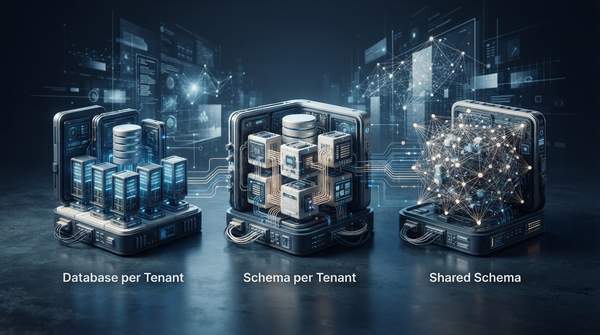
The selection of a multi-tenancy database pattern is a foundational decision for SaaS applications, impacting everything from cost efficiency and operational complexity to security, compliance, and scalability, as noted by John Adelana, a Senior Startups Solutions Architect at AWS. The three core patterns are Database-per-Tenant (Silo Model), Schema-per-Tenant (Bridge Model), and Shared Database with Tenant Identifier (Pool Model).
Database-per-Tenant: Dedicated Isolation
The database-per-tenant model, also known as the "Silo Model," provides the highest level of data isolation by dedicating a separate database instance to each tenant. This approach ensures complete logical and physical separation of tenant data, which can simplify regulatory compliance and enhance security, according to Supertokens. Each tenant's data resides in its own database, offering predictable performance with minimal "noisy neighbor" issues because resources are not shared directly between tenants.
While offering maximum isolation, this pattern comes with increased resource consumption and operational complexity as the number of tenants grows. Managing a large number of individual databases leads to higher operational overhead for tasks such as monitoring, schema management, and disaster recovery, as highlighted by Microsoft's Azure SQL Database guidance. Consequently, this model typically results in higher per-tenant costs due to the allocation of dedicated database resources for each tenant, making it generally the most expensive in terms of infrastructure. However, it allows for isolated schema changes and supports tenant-specific customizations, offering the highest degree of flexibility per tenant.
Schema-per-Tenant: Logical Separation
The schema-per-tenant model, often referred to as the "Bridge Model," represents a middle ground between the strong isolation of database-per-tenant and the consolidation of shared database tables. In this pattern, a single database hosts multiple schemas, with each tenant assigned its own schema. This approach provides logical data isolation within a shared database, meaning data is separated by schema, but all tenants share the same underlying database instance and its resources, as described by Supertokens.
This model balances isolation with resource sharing, offering a blend of both. However, sharing database resources introduces a potential for "noisy neighbor" issues, where the workload of one tenant can affect the performance experienced by others. Operational complexity can arise in schema management, particularly with a large number of tenants, as noted by Supertokens. Despite these challenges, the schema-per-tenant pattern makes it easier to extend an application's data model to support individual tenant needs and allows for tenant-specific customizations through configuration, according to Dell EMC's insights on multi-tenant SaaS applications.
Shared-Schema: Maximum Resource Utilization
The shared-schema model, also known as the "Pool Model" or "Shared Database with Tenant Identifier," maximizes resource utilization by storing all tenant data within a single database and a single schema. In this pattern, a tenant identifier column is added to each table to distinguish one tenant's data from another. This approach offers the highest level of resource consolidation and is generally the most cost-effective per tenant, especially for a large number of smaller tenants, as it minimizes infrastructure overhead.
However, this model presents the lowest level of data isolation, as all tenant data coexists within the same tables. This can introduce significant security and compliance challenges, requiring robust application-level logic to ensure data privacy and prevent unauthorized access between tenants. Performance can be highly susceptible to "noisy neighbor" issues, and managing schema changes becomes more complex because any modification affects all tenants simultaneously. Customizability is also limited, typically relying on configuration rather than structural changes. Operational complexity is generally lower for database management tasks like backups and scaling, but higher for application-level data segregation and query optimization.
Operational Complexities and Management Strategies
The choice of multi-tenancy database pattern profoundly impacts operational complexities, schema management, and disaster recovery strategies. Microsoft's Azure SQL Database documentation highlights these as key criteria for assessing tenancy models.
- Database-per-Tenant: This model incurs the highest operational overhead. Each database requires individual monitoring, backup, and restoration. Schema management is simpler for individual tenants, as changes can be applied to a single database without affecting others. However, managing schema evolution across hundreds or thousands of databases necessitates sophisticated automation. Disaster recovery involves restoring individual tenant databases, which can be complex and time-consuming for a large tenant base.
- Schema-per-Tenant: This pattern offers a moderate level of operational complexity. While the underlying database instance is shared, managing multiple schemas within it can still be intricate. Schema changes must be carefully planned to avoid impacting other tenants, and versioning across schemas can become challenging. Backup and restore operations are typically performed at the database level, meaning all tenants within that database are affected. Restoring a single tenant's data requires more granular, often application-level, recovery mechanisms.
- Shared-Schema: This model generally simplifies database-level operations like backups, scaling, and patching, as there is only one database and schema to manage. However, the complexity shifts to the application layer, which must enforce strict tenant isolation through every query and data access. Schema changes affect all tenants simultaneously, demanding careful design and testing to ensure backward compatibility. Disaster recovery is simpler at the database level, but restoring a specific tenant's data from a shared backup can be a highly complex and resource-intensive process, often requiring custom tooling to extract and re-insert data.
Multi-Tenancy Database Pattern Comparison Table
SaaS architects and developers can use this table to quickly compare the trade-offs of each multi-tenancy database pattern across critical architectural criteria, aiding in informed decision-making.
| Subject | Dimension | Finding | Qualification |
|---|---|---|---|
| Database-per-Tenant | Data Isolation | Provides the highest level of data isolation as each tenant's data resides in a dedicated database. | This model ensures complete logical and physical separation of tenant data. |
| Database-per-Tenant | Performance Impact | Offers predictable performance with minimal 'noisy neighbor' issues due to dedicated resources per tenant. | Performance is isolated, as one tenant's workload does not directly affect others. |
| Database-per-Tenant | Operational Complexity | Incurs higher operational overhead due to managing a large number of individual databases. | Tasks like monitoring, schema management, and disaster recovery are performed per database. |
| Database-per-Tenant | Cost Implications | Results in higher per-tenant costs due to the allocation of dedicated database resources for each tenant. | This model is generally the most expensive in terms of infrastructure. |
| Database-per-Tenant | Schema Management | Allows for isolated schema changes, making tenant-specific modifications easier to manage. | Schema evolution can be managed independently for each tenant. |
| Database-per-Tenant | Customizability | Supports tenant-specific customizations and schema extensions through configuration or direct modification. | This pattern offers the highest degree of customization flexibility per tenant. |
| Schema-per-Tenant | Data Isolation | Provides logical data isolation within a shared database, where each tenant has its own schema. | Data is separated by schema, but all tenants share the same underlying database instance. |
| Schema-per-Tenant | Performance Impact | Carries a potential for 'noisy neighbor' issues as tenants share database resources. | Performance can be affected by the workloads of other tenants within the same database. |
| Schema-per-Tenant | Operational Complexity | Presents moderate operational complexity, particularly in schema management across multiple schemas. | Schema changes require careful coordination to avoid impacting other tenants within the same database. |
| Schema-per-Tenant | Cost Implications | Offers moderate per-tenant costs due to shared database resources, more efficient than database-per-tenant. | Costs are lower than dedicated databases but higher than a fully shared schema. |
| Schema-per-Tenant | Schema Management | Allows for logical separation of schemas, but schema changes still require careful coordination within the shared database. | Schema evolution is more complex than database-per-tenant but less rigid than shared-schema. |
| Schema-per-Tenant | Customizability | Supports tenant-specific customizations through configuration and potentially schema extensions. | Offers a good balance of customizability and resource efficiency. |
| Shared-Schema | Data Isolation | Provides the lowest level of data isolation, relying heavily on application-level logic for separation. | All tenant data resides in the same tables, distinguished by a tenant identifier column. |
| Shared-Schema | Performance Impact | Highly susceptible to 'noisy neighbor' issues due to all tenants sharing the same database and tables. | Performance can fluctuate significantly based on aggregate tenant workloads. |
| Shared-Schema | Operational Complexity | Offers the lowest database-level operational complexity but shifts complexity to application-level data segregation. | Database management tasks are simplified, but application logic for tenant isolation is complex. |
| Shared-Schema | Cost Implications | Results in the lowest per-tenant costs due to maximum resource sharing and consolidation. | This model is the most cost-efficient for infrastructure, especially for a large number of small tenants. |
| Shared-Schema | Schema Management | Schema changes affect all tenants simultaneously, requiring careful design for backward compatibility. | Schema evolution is the most rigid, as any change impacts the entire tenant base. |
| Shared-Schema | Customizability | Offers limited customizability, primarily through configuration, as schema changes affect all tenants. | Customization is restricted to avoid breaking changes for other tenants. |
Choosing the Optimal Multi-Tenancy Pattern
Selecting the appropriate multi-tenancy database pattern requires a thorough evaluation of business requirements, security needs, and scaling goals. John Adelana of AWS emphasizes that this decision is one of the most critical when building a multi-tenant SaaS application, impacting cost efficiency, operational complexity, security, compliance, and scalability.
- For High Isolation and Customization: The database-per-tenant model is suitable for high-security environments where data isolation is non-negotiable, such as those with strict regulatory compliance requirements. This approach is also ideal when tenants require significant schema customizations or dedicated performance. However, architects must be prepared for higher infrastructure costs and increased operational overhead, particularly as the tenant count scales.
- For Balanced Isolation and Resource Sharing: The schema-per-tenant model serves as a middle-ground solution, balancing isolation with efficient resource utilization. It is often chosen when a moderate level of data isolation is acceptable, and the cost of dedicated databases for every tenant is prohibitive. This pattern requires careful schema management and monitoring to mitigate potential "noisy neighbor" issues, but it offers a good balance for many SaaS applications.
- For Cost Efficiency and High Tenant Volume: The shared-schema model is the most cost-effective per tenant, making it attractive for applications with a very large number of small tenants where individual tenant data volumes are low. This pattern prioritizes resource consolidation and operational simplicity at the database level. However, it demands robust application-level security and data segregation logic to ensure tenant data privacy and prevent performance degradation from shared resources.
Microsoft's Azure SQL Database guidance suggests assessing models based on criteria such as scalability (number of tenants, storage per-tenant, aggregate storage, workload), tenant isolation (data and performance), per-tenant cost, development complexity, operational complexity (monitoring, schema management, disaster recovery), and customizability. The optimal choice depends on which of these criteria are most critical for the specific SaaS offering.
Making an Informed Choice for Your SaaS Application
The selection of a multi-tenancy database pattern must align with specific business requirements for data isolation, cost efficiency, operational complexity tolerance, and future scaling goals. The chosen pattern should enable the application to meet its target Service Level Agreements (SLAs) for performance and availability while remaining within defined budget constraints for infrastructure and operational costs.