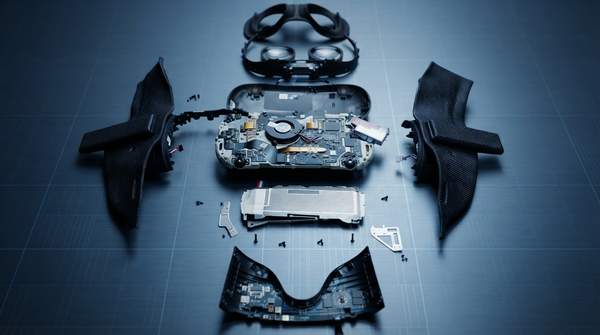
There is no single best display technology for AR and VR headsets — there is only the best fit for your design priorities. If you need the smallest possible glasses form factor with deep blacks, Micro-OLED is the leading candidate. If outdoor brightness is the constraint, LCoS, DLP or Laser Beam Scanning (LBS) all outperform it. If you want proven maturity with high brightness, LCoS and DLP dominate, but they demand more from your optical and power budgets. This guide breaks down each technology's core trade-off and closes with a decision matrix you can apply directly to your product requirements.
Micro-OLED: Compactness and Contrast
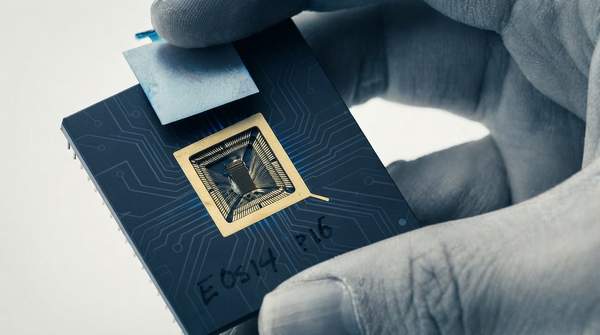
Micro-OLED (also called OLEDoS) builds pixels directly on a CMOS silicon backplane with deposited organic emitting layers, making it a self-emissive display. Because each pixel generates its own light, pixels that are off are truly black — the peer-reviewed comparison in Light: Science & Applications rates its contrast ratio at roughly 10,000:1, an order of magnitude above LCoS and DLP panels. That true black state is what gives emissive displays their intrinsically high dynamic range.
The trade-off is brightness. The same comparative survey places Micro-OLED output at 10³–10⁴ nits, a full order of magnitude below the 10⁴–10⁵ nits typical of LCoS and DLP. UBIResearch analyst Chang-ho Noh identifies a second structural weakness: the trade-off between luminance and lifetime. Pushing an organic-emitter panel harder for outdoor-visible brightness shortens its usable life.
Where Micro-OLED wins decisively is integration. It carries a small form factor and low optical system complexity in the comparative table, and its high light efficiency means less of your power budget goes to waste. For compact VR headsets and indoor AR where contrast and color quality matter more than peak luminance, it is the natural choice — provided your application does not demand extreme brightness for outdoor visibility.
LCoS: Balancing Resolution and Brightness
Liquid-crystal-on-silicon is a reflective projection technology: a liquid-crystal layer on a silicon backplane modulates light from a separate source. It earns a "high" maturity rating and delivers 10⁴–10⁵ nits of brightness — enough headroom for bright-environment AR when paired with the right optics. Contrast sits around 1,000:1, and its form factor is classified as large relative to the other microdisplays, with medium optical system complexity.
The catch is efficiency. The comparative survey rates LCoS light efficiency as low, and the reason is physical: LCoS requires polarized light, so a polarizer discards much of the source output before it ever reaches the panel. Power behavior is also content-dependent. As a SID-published analysis explains, LCoS electrical power consumption is mainly determined by the average picture level (APL) and the liquid-crystal mode — for "normally white" MTN LCoS, darker content actually consumes more electrical power, because voltage is required to reorient the liquid crystals into their dark state.
That content dependence matters for battery-life modeling: your worst-case power draw depends on your UI's typical APL, not just on panel size. Industry analysis by Karl Guttag notes that companies previously using DLP switched to LCoS, citing smaller pixels — and thus a smaller device for a given resolution — plus lower display-plus-ASIC power consumption, more choice in resolutions and form factors, and cost. A recent SID digest reinforces that LCoS remains dominant for near-term AR applications due to manufacturing readiness, with compact modules now demonstrated at 0.7 cc.
DLP: Robustness and Established Performance
Digital Light Processing uses a digital micromirror device (DMD) whose mirrors tilt to steer light, rather than a liquid-crystal layer. It matches LCoS on the headline numbers — high maturity, 10⁴–10⁵ nits, roughly 1,000:1 contrast, medium optical complexity — but it holds one genuine efficiency edge. As Xiong and colleagues explain in their Light: Science & Applications review, the DMD does not require polarized light, so it generally exhibits higher efficiency than LCoS when an unpolarized light source is employed.
Against that advantage stand two costs. The comparative table rates DLP's light efficiency as only medium overall and its form factor as medium — larger than LCoS for a given resolution, per the industry shift Guttag documents. Companies migrating away from DLP consistently named pixel size and power consumption as their reasons.
DLP remains a viable option where its specific characteristics are advantageous: it is a mature, robust architecture with strong brightness, and its unpolarized-light efficiency can win in designs where the source, not the modulator, dominates the power budget. But if your product goal is the smallest engine at a given resolution, the evidence points toward LCoS instead.
Laser Beam Scanning (LBS): The Promise of Form Factor
LBS abandons the panel entirely. MEMS micromirrors scan RGB laser beams to draw a 2D image directly, with gray levels produced by pulse-width modulation of the laser diodes — either one 2D scanning mirror or two 1D mirrors with a focusing lens. The small size of the MEMS mirror, as Xiong and colleagues note, offers a very attractive form factor, and the comparative survey rates LBS as high brightness, high light efficiency, small form factor and roughly 100,000:1 contrast.
The unique property is that scanning displays have no object plane. Where panel displays form an image on the panel, LBS can form the image directly on the retina — the principle behind the Maxwellian-view displays used in North Focals. This is the specific context in which LBS achieves its high-resolution claims; it is not a general panel-style resolution metric.
The price is complexity. Because most scanning engines have an intrinsically small exit pupil, they need exit-pupil expansion or steering, making the optical design more sophisticated — the comparative table rates LBS optical system complexity as high, with only medium maturity. If your team has the optical expertise to manage pupil expansion, LBS offers a uniquely compact, bright, high-contrast engine. If not, that sophistication is a project risk.
AR/VR Display Technology Decision Matrix
Use this matrix to map your top design priority to the technology whose evidence profile matches it. The ratings are relative classifications from the comparative survey of AR light engines, with brightness figures as reported general ranges — actual performance depends on implementation.
| Technology | Brightness | Efficiency | Form factor | Optical complexity | Contrast | Best-fit product archetype |
|---|---|---|---|---|---|---|
| Micro-OLED | 10³–10⁴ nits | High | Small | Low | ~10⁴:1 | Compact VR and indoor AR where contrast, color and battery life dominate |
| LCoS | 10⁴–10⁵ nits | Low | Large | Medium | ~10³:1 | Bright-environment AR needing proven maturity and high resolution at moderate risk |
| DLP | 10⁴–10⁵ nits | Medium | Medium | Medium | ~10³:1 | High-brightness designs where unpolarized-light efficiency and robustness matter |
| LBS | >10⁴ nits | High | Small | High | ~10⁵:1 | Lightweight AR glasses, if your team can handle sophisticated exit-pupil optics |
Reading the matrix is straightforward: rank your priorities, then find the row whose strengths align. Prioritizing battery life and compactness points to Micro-OLED or LBS. Prioritizing outdoor brightness points to LCoS, DLP or LBS. Prioritizing low development risk points to the high-maturity options, LCoS and DLP. Note that Micro-LED also appears in the comparative survey — rated high on brightness, efficiency, form factor and contrast — but with low maturity, and full-color and red-efficiency challenges remain unresolved, so it is a long-term contender rather than a near-term selection.
Making the Right Choice for Your AR/VR Headset
The optimal AR/VR display technology depends directly on the primary design priorities of the headset, requiring a careful trade-off analysis between form factor, brightness, power consumption, and system complexity. Micro-OLED suits compact, contrast-critical, indoor-first products; LCoS suits brightness-hungry AR that can absorb a larger engine and content-dependent power; DLP suits robust high-brightness designs tolerant of a medium form factor; LBS suits ambitious lightweight glasses backed by strong optical engineering. This comparison covers the light engines themselves, based on publicly available technical papers and industry analysis rather than proprietary datasheets or lab testing, and it does not address combiner and waveguide optics.
The measurable indicator of a correct choice is a successful product launch and positive user feedback regarding visual experience, battery life, and device comfort, aligning with the chosen display technology's strengths. Before committing, validate the two numbers most sensitive to your use case against vendor datasheets: achievable nits at your target ambient light level, and worst-case power draw at your UI's typical average picture level — the two variables where the evidence shows the largest spread between these four technologies.