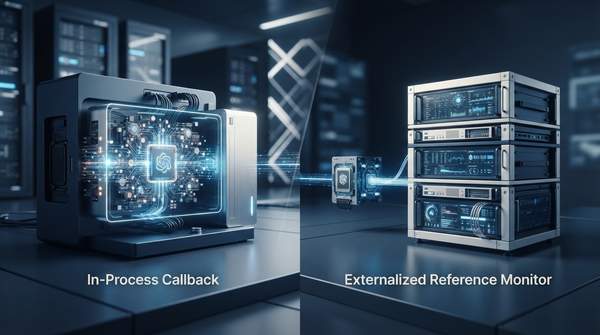
Every major coding agent now ships hooks, and the architecture you choose for them determines whether they act as a developer convenience or a genuine enterprise security control plane. The practical decision boundary is sharp: an In-Process Callback, where scripts run inside the agent's own execution environment, suits local development and simple automation, while an Externalized Reference Monitor, which forwards structured events to a centralized policy backend, is the pattern for production enterprise systems that need governance and auditability. This article contrasts the two patterns and gives a framework for choosing between them.
Introduction to Agent Hooks: Bridging AI and Enterprise
An AI agent hook is a user-defined handler — a script, an HTTP endpoint, an MCP tool, or a small LLM prompt — that fires at a specific point in an agent's lifecycle. Hooks receive structured JSON about the event and can observe, log, modify, or block before execution proceeds. Claude Code, Cursor, OpenAI Codex, and VS Code Copilot all expose hooks today.
The significance for enterprises is that the primitive has settled into a consistent shape. As Sullivan puts it, organizations can start treating hooks as the foundation for building an AI control plane to enable governance, rather than a per-vendor curiosity. Dataiku's enterprise AI agents guide, written by Mark Abramowitz, echoes the same idea from the platform side: governance hooks are built-in checkpoints that enable human review and audit trails at every stage, alongside memory persistence, planning modules, and controlled tool integration.
The architectural question is therefore not whether to use hooks, but where they run and who owns the policy they enforce. Two patterns dominate.