
Sarah Chen
Editorial byline
Sarah Chen is an editorial byline for Coders & Pixels, with a focus on Dev Tools, Back-End Infrastructure, Productivity & Workflow. Biographical credentials and external profiles are published only after verification.
Learn more about our editorial process and use of automation in our AI & Automation disclosure.
Coverage Areas
Latest Articles

Choosing an Integration Pattern for AI Agents in Your Developer Tools and CI/CD Pipeline
Choosing the right integration pattern for AI agents in developer tools and CI/CD pipelines involves balancing the number of tools, infrastructure investment, and organizational security governance. Four dominant architectural patterns—direct API calls, tool-use libraries, MCP gateways, and agent-to-agent communication—offer different trade-offs in complexity, scalability, and security.
Nov 7, 2026 · 7 min read
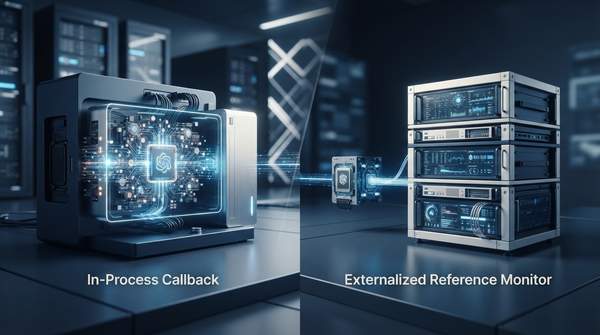
Agent Hooks, Two Ways: The In-Process Callback vs. the Externalized Reference Monitor
AI agent hooks offer two primary architectural patterns: In-Process Callback for local development and Externalized Reference Monitor for enterprise security. The choice between them determines whether hooks serve as developer convenience or a robust control plane for governance and auditability.
Nov 6, 2026 · 6 min read

How Homomorphic Encryption Enables Multi-Party Computation: Architecture, Overhead, and the SaaS Decision
Homomorphic encryption (HE) provides a cryptographic foundation for secure multi-party computation (MPC), enabling joint evaluation of functions on private inputs without revealing them. While offering non-interactive computation attractive for SaaS, it incurs significant computational overhead, necessitating careful trade-off analysis.
Nov 5, 2026 · 6 min read

Platform Engineering vs. DevOps and SRE: A Decision Framework for Your First Internal Developer Platform Project
Platform engineering scales DevOps by centralizing infrastructure complexity into a self-service internal developer platform, focusing on developer pain points. This article provides a decision framework for prioritizing your first internal developer platform project, distinguishing it from DevOps and SRE.
Oct 31, 2026 · 5 min read

How Kubernetes Operators Automate Application Lifecycles—and How the Operator Lifecycle Manager Automates the Operators
Kubernetes Operators automate complex application lifecycles, but managing many Operators introduces new challenges. The Operator Lifecycle Manager (OLM) addresses this by providing a declarative framework for installing, managing, and upgrading Operators and their dependencies, ensuring cluster stability and operational efficiency.
Oct 30, 2026 · 4 min read

K3s or MicroK8s? Picking the Right Lightweight Kubernetes for the Edge
For resource-constrained edge deployments, the choice between K3s and MicroK8s hinges on a core trade-off: K3s offers a minimalist, smaller footprint, while MicroK8s provides a more complete, self-contained Kubernetes experience. The right pick depends on hardware limitations and desired convenience.
Oct 27, 2026 · 6 min read

Shared, Schema-per-Tenant, or Database-per-Tenant: Picking the Right Multi-Tenant Model for Your SaaS
Choosing the right multi-tenant database architecture for your SaaS platform requires balancing isolation, cost, and operational complexity. The optimal model—pooled, schema-per-tenant, or database-per-tenant—depends on current tenant profiles and future scaling/compliance needs, often suggesting a phased or hybrid strategy.
Oct 27, 2026 · 6 min read

HNSW vs. IVFFlat vs. ANNOY: Choosing the Right Vector Index for Your Generative AI Application
Choosing the right vector index for generative AI applications involves understanding the trade-offs between HNSW, IVFFlat, and ANNOY. The optimal choice depends on matching the index to your application's dominant constraints, such as data dynamism, memory resources, and query performance requirements.
Oct 25, 2026 · 5 min read

Six Copilot Models Retired Today: The Official Migration Map and What to Check Now
GitHub Copilot is retiring six AI models on October 19, 2026, impacting custom workflows and agentic tasks. Developers must consult the migration map and audit their integrations to ensure a smooth transition and avoid potential breakage.
Oct 19, 2026 · 4 min read

Unified or Specialized? How to Choose a SaaS Monetization Platform by Architecture, Not Feature List
SaaS architects face a critical decision: choose a unified monetization platform or specialized layers based on architectural fit, not feature checklists. This choice impacts where pricing logic resides, influencing integration complexity and operational efficiency.
Oct 18, 2026 · 6 min read

Choosing Between LIME, SHAP, and Permutation Importance: A Practical Guide to Model-Agnostic Explainability
This guide compares LIME, SHAP, and Permutation Importance, three model-agnostic techniques for explaining black-box models. It helps you choose the right method based on whether you need local or global explanations, computational budget, and data characteristics.
Oct 17, 2026 · 6 min read

SBOMs, Code Signing, and Build Attestation: How to Architect a Verifiable Software Supply Chain
A verifiable software supply chain is built by integrating three key mechanisms: SBOMs to document components, code signing for integrity, and build attestation for process verification. This integrated workflow creates a verifiable chain of custody for software artifacts, crucial for mitigating supply chain threats.
Oct 15, 2026 · 5 min read

Namespace Raises $42M to Target Developer Pain Points With Custom Cloud
Developer infrastructure startup Namespace has secured $42 million in Series B funding to expand its custom compute cloud, designed to address performance bottlenecks and workflow frustrations developers face with generic cloud services. The company's vertically integrated architecture aims to accelerate CI/CD pipelines and provide optimized cross-platform development environments.
Oct 6, 2026 · 4 min read

Portal, Catalog, or Golden Path? Understanding Core IDP Components
An Internal Developer Platform (IDP) is an integrated system of components, not a single tool, designed to abstract complexity and enhance developer experience. The article details the three core building blocks—developer portal, software catalog, and golden path templates—explaining their distinct roles and synergistic functions.
Oct 4, 2026 · 4 min read

Uber Deploys MCP Gateway, Revealing a Blueprint for Enterprise AI Governance
Uber has deployed its Model Context Protocol (MCP) Gateway, a platform designed to manage AI agent interactions and provide a blueprint for enterprise AI governance. This system utilizes a dual-plane architecture and integrated security to ensure accountability and scalability across thousands of internal services.
Oct 3, 2026 · 4 min read

A Developer's Guide to NVIDIA's DIN Deploy Workflow for C++ AI Apps
NVIDIA's DIN Deploy provides open-source C++ samples to streamline the creation of local AI applications. This workflow separates Python-based model preparation into ONNX format from high-performance C++ inference deployment using ONNX Runtime and TensorRT RTX on NVIDIA GPUs.
Oct 2, 2026 · 4 min read

Integrating WebAssembly Modules for Secure, Portable Server-Side Execution
WebAssembly (Wasm) is expanding beyond browsers for secure, portable, high-performance server-side and edge computing. By leveraging WASI and specialized runtimes like Wasmtime and Wasmer, developers can simplify deployment and enhance scalability for modern applications.
Sep 30, 2026 · 6 min read

Top 5 SaaS Security Posture Management Tools for 2026
Despite a 40% increase in enterprise spending on SaaS security tools last year, 62% of cloud breaches still originate from preventable misconfigurations, often within the very applications these SaaS
Sep 16, 2026 · 6 min read

Oracle Posts Strong Q1 FY27 Cloud Revenue Growth Fueled by AI
Oracle closed over $30 billion in new AI contracts in Q1 FY27 without requiring additional Oracle capital, according to CRN .
Sep 13, 2026 · 3 min read

AI Agent Tools Reshaping Developer Workflows: New Security Risks
In the first half of 2026, GitProtect Lab tracked 84 AI-related incidents, highlighting a critical new vulnerability in developer workflows.
Aug 20, 2026 · 5 min read