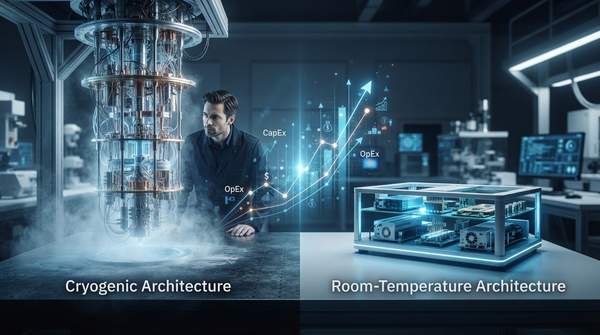
The single biggest cost decision in quantum computing is architectural: whether your qubits live at millikelvin temperatures or at room temperature. A superconducting system carries a ten-year total cost of ownership of roughly $8.8 million, with cryogenic infrastructure dominating both the purchase price and the recurring operating bill, according to a cost and procurement analysis by Marin Ivezic on PostQuantum.com. Neutral-atom and ion-trap machines sidestep that infrastructure entirely, eliminating components that individually run from tens of thousands to millions of dollars. Within any architecture, two engineering levers—integrated cryogenic control electronics and smarter compilers—can further bend the cost curve.
Cryogenic vs. Room-Temperature Architectures: A Cost Comparison
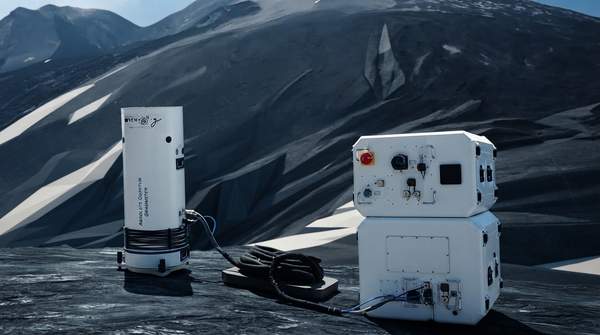
The dividing line between quantum computing platforms is temperature. Superconducting qubits, built from Josephson junctions on 2D surfaces, must be held near absolute zero—around −450°F, per a platform comparison by Quandela's Valérian Giesz—to preserve coherence, which lasts under 300 microseconds but enables very fast gate operations. Ion traps and neutral atoms, by contrast, operate at room temperature, using confined ions manipulated by lasers or individual atoms held in optical tweezers.
An industry analysis posted on arXiv notes that ion traps' room-temperature operation simplifies cooling requirements and can ease integration with classical control systems, while their high qubit connectivity permits more flexible circuit designs. The financial consequence is structural: the facility preparation and cryogenic infrastructure costs that dominate a superconducting budget simply disappear for neutral-atom systems, as the PostQuantum analysis puts it. The trade-off is speed and manufacturing maturity—superconducting fabrication resembles semiconductor manufacturing, while room-temperature platforms trade slower, laser-driven control for dramatically simpler facilities.
Comparative Cost Breakdown of Quantum Computing Architectures
The table below juxtaposes the itemized capital and operational costs of a cryogenic superconducting deployment against a room-temperature neutral-atom or ion-trap system, isolating where each architecture's money actually goes. The comparison shows why non-cryogenic systems can achieve lower total cost of ownership: they delete specific multi-hundred-thousand-dollar components and the recurring expenses attached to them.
| Dimension | Superconducting | Neutral-Atom / Ion-Trap |
|---|---|---|
| Operating environment | Near absolute zero (about −450°F), requiring dilution-refrigerator infrastructure | Room temperature; no cryogenic cooling required |
| Key capital expenditures | Cryostat ($700K–$2.5M), helium-3 charge and recovery system ($180K–$280K), chilled-water plant ($50K–$100K), vibration isolation slab ($50K–$100K), EMI shielding ($50K–$150K), QPU, control electronics, wiring; facility prep $200K–$400K | No cryostat, helium-3 system, or chilled-water plant; facility preparation drops to a fraction of superconducting levels in an HPC environment with adequate floor space, power, and cooling |
| Key operational expenditures | Specialized personnel including a cryogenic engineer (~$150K/year), annual cryostat maintenance, helium-3 top-ups of $15K–$30K per warm-up event ($15K–$50K annually) | No cryogenic engineer role or helium-3 management; specialized personnel still required |
| Primary cost reduction strategy | Integrate cryo-CMOS control electronics to manage power dissipation; use advanced compilers to cut error-correction qubit overhead | Architectural elimination of cryogenics; higher-fidelity qubit control to reduce error-correction overhead |
One concrete illustration from the PostQuantum analysis: a Pasqal Orion deployment at 140+ qubits removes every cryogenic line item listed above, though the vendor does not publicly disclose system pricing. For superconducting systems, the ratio of year-zero capex to five-year TCO runs roughly 1:2.6—every dollar of hardware purchase brings about $1.60 of operating cost over five years, a ratio that improves with scale but, per the analysis, never falls below 1:2.
Capital Expenditures: Cryostats, Shielding, and QPU
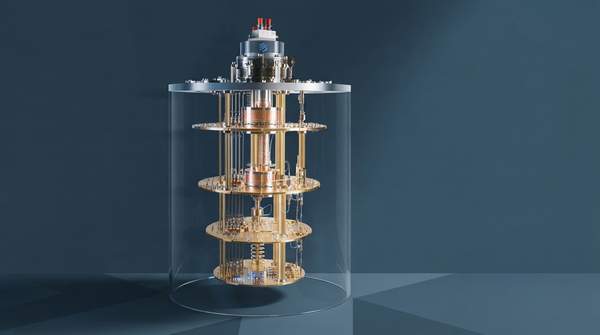
The superconducting capital budget is a stack of interdependent line items, each tied to the millikelvin requirement. The cryostat itself is the largest single component at $700,000 to $2.5 million. Around it sit the helium-3 charge and recovery system ($180K–$280K), the chilled-water plant ($50K–$100K), the vibration isolation slab ($50K–$100K, reduced rather than eliminated even in non-cryogenic deployments), and EMI shielding ($50K–$150K). Facility preparation adds another $200K–$400K before a single qubit runs.
These figures are estimates for building and operating on-premise systems, drawn from publicly available analyses rather than vendor pricing, and they exclude cloud access costs. The refresh cycle matters as much as the sticker price: the $8.8 million ten-year TCO figure assumes a control electronics module refresh in year five and a second QPU refresh in year seven, meaning the capital budget recurs, it does not conclude at purchase.
Operational Expenditures: The Hidden Costs of Cryogenics
Recurring costs are where first-time operators get surprised, according to the PostQuantum procurement guide. Helium-3 is the clearest example: the initial charge is a capital item, but recovery, purification, and top-up after each warm-up event are operational expenses. Budget $15,000 to $30,000 per warm-up for helium-3 handling; with at least one planned warm-up per year and the possibility of unplanned events, annual helium-3 opex runs $15,000 to $50,000 depending on system reliability.
Add the cryogenic engineer role at roughly $150,000 per year and annual cryostat maintenance, and the pattern becomes clear: the machine that costs millions to buy also demands a permanent staff and consumables budget that scales with how reliably the cold chain holds. Every unplanned warm-up is not just downtime but a five-figure invoice. Room-temperature architectures convert most of these recurring lines into fixed, modest facility costs—power, floor space, and conventional cooling.
Cost Reduction Strategy 1: Integrating Control Electronics
For teams committed to superconducting qubits, the control stack is the main internal cost lever. Conventional architectures route room-temperature electronics into the fridge through dense wiring, which limits scaling. Cryo-CMOS moves mixed-signal control—waveform synthesis, digitization, and local buffering—onto chips inside the cryostat, naturally suited to the 4 K stage, as a cryoelectronics integration paper on arXiv describes.
The binding constraint is heat. Bardin and colleagues reported a 28-nm bulk-CMOS cryogenic controller for transmons dissipating less than 2 mW per physical qubit, and Microsoft and collaborators demonstrated a CMOS platform operating around 100 mK for quantum-dot devices. But the arXiv analysis cautions that milliwatt-class dissipation per qubit, multiplied across a fault-tolerant machine, can force large form factors or substantial 4 K cooling budgets—so integration trades wiring complexity against refrigeration capacity, and stage-wise cooling power dictates where each function can physically live.
Cost Reduction Strategy 2: Advanced Compilers and Error Correction
The second lever is software: error correction multiplies every logical qubit into many physical qubits, so anything that shrinks that overhead shrinks the entire hardware bill. A University of Central Florida effort led by Niu, reported by Quantum Zeitgeist, is developing a compiler and resource estimation approach built around partial error protection, which Niu says "could avoid some of the extra qubits and time required by fully fault-tolerant designs to perform such rotations." The trade-off is residual error in analog rotations, which may require repetition until success—trading hardware count for runtime.
Compiler gains compound with hardware improvements. An industry roadmap analysis on arXiv notes that providers like IBM and IQM foresee rapid advances in coherence times, gate fidelities, and physical qubit counts, and that better fabrication steadily improves superconducting qubit performance. Higher-fidelity operations mean fewer physical qubits per logical qubit, which is why error management belongs in any cost model alongside cryostats and helium.
Evaluating Economic Viability: A Strategic Decision
Organizations evaluating quantum computing investments should prioritize architectures that minimize cryogenic infrastructure for lower total cost of ownership, while weighing integrated control electronics and compiler-level error management for scalability within a chosen platform. The decision framework is straightforward: if your use case tolerates the gate speeds and control schemes of neutral-atom or ion-trap systems, you delete a $700K–$2.5M cryostat, a $180K–$280K helium-3 system, and a $150K/year cryogenic engineer; if you need superconducting speed, budget a five-year TCO of roughly 2.6 times your year-zero capex and plan for helium-3 opex of $15K–$50K annually.
A key observable signal for economic viability will be the reduction in capital expenditure for non-cryogenic systems and the decrease in recurring operational costs associated with helium management and cryostat maintenance. Watch whether vendors like Pasqal begin disclosing system pricing, and whether cryo-CMOS controllers push per-qubit dissipation below the roughly 2 mW benchmark—both would sharpen the comparison this analysis can currently only bound.
Sources
- Quantum Computer Cost: Build and Operations Guide — PostQuantum.com
- Exploring Types of Quantum Computers: Which Technology Leads? — Quandela
- Quantum Computing – Strategic Recommendations for the Industry — ARXIV
- Integration and Resource Estimation of Cryoelectronics for Superconducting Fault-Tolerant Quantum Computers — ARXIV
- Niu Leads UCF Effort To Cut Quantum Computing Costs — Quantum Zeitgeist