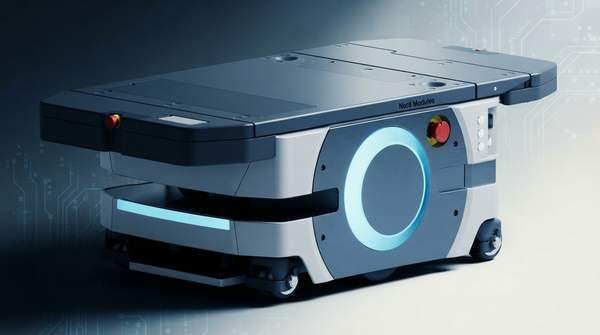
Omron Robotics has announced the next generation of its flagship LD Series of autonomous mobile robots (AMRs), introducing the LD-150 and LD-300 models. Revealed ahead of a demonstration at the Automate 2026 conference, the new robots are designed to handle heavier transport tasks in compact industrial environments. The new models feature significantly increased payload capacities, faster speeds, and rapid wireless charging to improve material flow and operational uptime in manufacturing and logistics facilities.
Omron LD-150 vs. LD-300: Key Specifications at a Glance
The primary distinction between the two new models is the trade-off between payload capacity and physical size. The LD-300 doubles the carrying capacity of the LD-150 but requires a slightly larger footprint. Both models share significant upgrades in speed, charging technology, and safety compliance, offering a consistent performance baseline across the new series.
| Specification | Omron LD-150 | Omron LD-300 |
|---|---|---|
| Maximum Payload | 150 kg (330.7 lb) | 300 kg (661.4 lb) |
| Footprint (W x L) | 500 mm x 700 mm | 580 mm x 800 mm |
| Maximum Speed | 2.1 m/s (4.7 mph) | 2.1 m/s (4.7 mph) |
| Charging | Wireless inductive charging in 30 minutes or less | Wireless inductive charging in 30 minutes or less |
| Safety Compliance | ISO 3691-4:2023 | ISO 3691-4:2023 |
Advanced Features for Efficiency and Safety
Both the LD-150 and LD-300 incorporate several key enhancements aimed at improving performance in demanding production environments. According to Omron, the robots can achieve a maximum speed of 2.1 m/s and feature fast wireless inductive charging that can be completed in 30 minutes or less, maximizing their operational availability. The new models are also engineered to navigate more complex facility layouts, with the ability to traverse 5-degree grade ramps. On the safety front, the robots comply with the ISO 3691-4:2023 standard for industrial mobile robots and offer up to 360-degree safety scanner coverage to operate safely alongside human workers.
Seamless Integration and Operational Advantages
Omron designed the new AMRs to integrate into complex industrial workflows without requiring major infrastructure modifications. Unlike traditional automated guided vehicles (AGVs) that follow fixed paths, these robots adapt dynamically to changing environments. According to Justin King, Vice President of Product Management at OMRON Robotics, the new models provide "a more flexible AMR platform for heavier transport tasks in tighter spaces." The robots are managed by Omron's FLOW Core software, which coordinates traffic and manages workflows, simplifying deployment and enabling the new models to operate alongside existing Omron mobile robot fleets.
Availability and Market Impact
The introduction of the LD-150 and LD-300 expands Omron's offerings for high-throughput material transport. The company stated that the new models are intended for facilities that need to automate the movement of heavier materials within confined spaces, such as in manufacturing, logistics, and material handling industries. Shipping for the new LD series robots is expected to begin in the fourth quarter of 2026. The enhanced capabilities aim to help operations teams reduce manual transport and scale their automation efforts more effectively.
Assessing Suitability for Industrial Automation
For companies evaluating these new AMRs, the choice between the models hinges on specific operational needs. Industrial automation professionals should evaluate the LD-150 for compact spaces and loads up to 150kg, and the LD-300 for heavier material transport up to 300kg, considering the trade-off between payload and footprint. The key performance indicator for a successful rollout will be the successful deployment and integration of either the LD-150 or LD-300 into a facility's existing material flow, indicated by improved throughput and reduced manual handling.