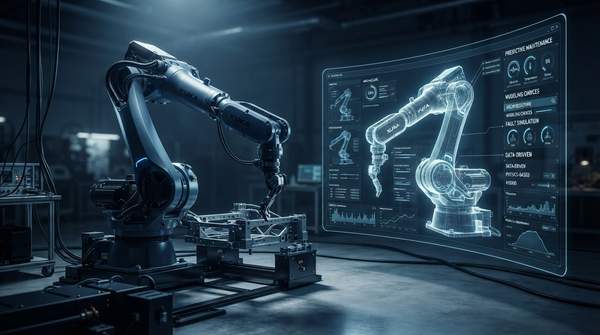
A digital twin for an industrial robot is a high-fidelity simulation of the physical asset, and its most practical near-term payoff is predictive maintenance: using sensor data and machine learning to detect faults and predict failures so that maintenance happens only when needed. The core technical challenge, as Steve Miller of MathWorks frames it, is that real-world fault data is scarce—you cannot let a robot joint fail catastrophically just to collect training examples. The architecture that solves this problem has distinct layers, and the modeling strategy that works best is usually a hybrid one.
Understanding Digital Twins for Industrial Robotics
A digital twin is more than a 3D model of a robot arm. It is a living simulation that stays connected to the physical machine, receiving its sensor data and reflecting its actual condition. In predictive maintenance, the twin serves two roles: it mirrors the robot's healthy behavior so deviations become visible, and it acts as a test bench where faults can be injected safely in software.
That second role matters because of how industrial robots fail. Permitting faults to occur in the field, Miller notes, may lead to catastrophic failure and destroyed equipment, while generating faults intentionally under controlled circumstances may be time-consuming, costly, or even unfeasible. A digital twin sidesteps both problems by generating sensor data for fault conditions through simulation. For a robot, that means the twin must capture the behavior of joints, actuators, and the control system—not just geometry.
Layered Architecture of a Robotics Digital Twin
Research on robotic digital twins, including work presented at the 2022 IEEE Conference on Industrial Electronics and Applications on a digital twin for a typical robotic pick-and-place process, points to a consistent structural pattern. The system separates into a physical side and a virtual side, connected by data. The physical layer is the robot itself: its body, sensors, and actuators. The virtual layer holds the robot's geometric, kinematic, dynamic, and control models, along with the simulation and analysis capabilities that run on them.
Between these layers sits the data infrastructure—acquisition, storage, and processing—that keeps the virtual model synchronized with the real machine. The value of this separation is modularity: you can refine the friction model in a pick-and-place twin, as the IEEE study did to improve physical-model consistency, without touching the physical robot. The framework below maps how information moves through these layers to produce a maintenance decision.
Conceptual Architecture of an Industrial Robot Digital Twin for Predictive Maintenance
Use this framework to locate where each technology—sensing, simulation, machine learning, and decision logic—fits in the overall pipeline, and to trace how a reading from a physical joint becomes an actionable maintenance prediction.
| Layer | Components | Function in the pipeline |
|---|---|---|
| Physical layer | Robot body, sensors, actuators | Source of observed data; target of maintenance actions |
| Data layer | Acquisition, storage, processing | Carries sensor readings from robot to model and decisions back out |
| Virtual layer | Geometric, kinematic, dynamic, and control models; simulation and analysis | Mirrors robot behavior; generates synthetic fault data across conditions and severities |
| Application layer | Machine learning models, fault detection, prediction | Converts real and simulated data into failure predictions and maintenance timing |
The reasoning path is straightforward: the physical layer produces observations, the data layer moves and conditions them, the virtual layer supplies both the reference model of healthy behavior and simulated fault behavior, and the application layer compares the two to flag a developing failure. Each layer depends on the one before it—prediction quality is bounded by sensor quality and model fidelity.
Physics-Based Models: Simulating Reality
A physics-based, or mechanism, model describes the robot using mathematical models of its components. An overview of predictive maintenance based on digital twin technology explains that these can include control models, mechanical models, and hydraulic models, and that modeling the equipment mathematically enables multi-domain model coupling—critical for robots, where electrical, mechanical, and control dynamics interact at every joint.
The strength of this approach is coverage. A library of physics-based models, as researchers at the University of Texas at Austin demonstrated in their work on interpretable predictive digital twins, can generate a rich dataset containing predictions of observed quantities for a wide range of asset states—including fault conditions you would never deliberately create on a production robot. The cost is fidelity: the IEEE pick-and-place study found that the twin's physical model satisfied consistency requirements only within an acceptable range, and that a modified friction model was needed to improve it. Physics models are approximations that must be validated against the real machine.
Data-Driven Models: Learning from Patterns
Data-driven models take the opposite approach: rather than encoding physics, they use machine learning to detect faults and predict failures directly from sensor data. Their advantage is adaptability—they capture effects that are hard to model explicitly, such as site-specific wear patterns, and they are what actually runs in service, monitoring the live robot against learned patterns of normal and faulty behavior.
Their weakness is the mirror image of their strength. Machine learning models need training data, and as Miller points out, limited access to real-world fault data restricts model training. A robot fleet that has been well maintained offers few examples of the bearing degradation, gear wear, or actuator faults you most need to recognize. Without representative fault data, a data-driven model can only flag anomalies, not identify specific failure modes or their severity.
Hybrid Approaches: Combining Strengths
This is where the two approaches converge. Combining physics-based modeling, simulation, and machine learning, as Miller describes, enables the development and deployment of predictive algorithms for in-service monitoring. The physics-based twin generates synthetic sensor data across fault conditions and severities—covering fault combinations that would be dangerous or unfeasible to produce physically—and that synthetic data trains the machine learning model that then monitors the real robot.
The Texas researchers offer a concrete pattern for the combination: their approach uses a library of physics-based models to generate training data, then trains an optimal classification tree that identifies which model in the library best matches observed data, enabling online model adaptation. Demonstrated on a fixed-wing UAV using structural sensors to detect wing damage, the principle transfers directly to robots: match live sensor behavior against a library of simulated healthy and degraded states. Hybrid modeling is not merely convenient—it is often the only way to get labeled fault data at all.
From Sensor Data to Maintenance Prediction
Putting the layers together, the workflow runs as follows. Sensors on the robot's joints and actuators stream measurements through the data layer into the twin. The virtual layer simulates the robot's expected behavior, including synthetic runs of fault conditions. The application layer's trained model compares observed data against these references, detects deviations consistent with specific fault modes, and predicts failures early enough to schedule maintenance before breakdown. The output is a decision: which component needs attention, and when.
Two boundaries are worth stating plainly. This is a conceptual architecture, not an implementation guide for a specific robot model or software platform—component choices and interfaces vary by vendor. And while digital twins also support process optimization and simulation-driven design, the workflow above is specific to predictive maintenance; other applications follow different data flows.
Implementing Predictive Maintenance with Digital Twins
The evidence points to one clear decision: implement a hybrid digital twin modeling approach for industrial robots to overcome limitations of scarce real-world fault data and enhance predictive maintenance capabilities. Purely physics-based twins struggle with fidelity; purely data-driven models starve without fault examples. The hybrid pattern—simulate faults, train on the results, monitor in service—resolves both constraints.
To know whether your twin is working, monitor the accuracy and lead time of fault predictions generated by the digital twin, especially for novel or rare failure modes, and track the reduction in unplanned downtime. Those two measures, prediction quality and downtime avoided, are the measurable outcomes that separate a functioning predictive maintenance system from an impressive simulation.