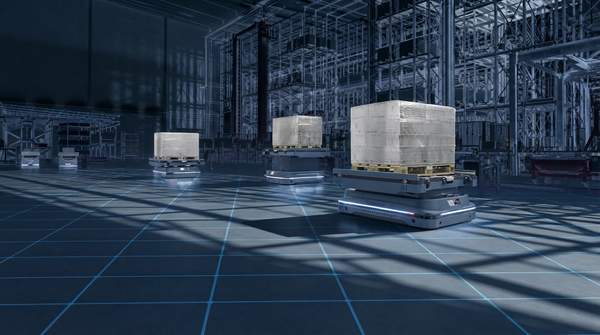
Scaling an industrial robot fleet is not a purchasing exercise. The four challenges that most often decide whether an expansion succeeds are fleet heterogeneity, network and controller capacity, data infrastructure, and integration with legacy systems. Each hits a different axis of your operation: operational efficiency, integration complexity, and maintenance overhead. And each one gets worse in kind, not just in degree, as your fleet grows from a handful of units to hundreds. Here is how to see them coming before they cap your fleet.
Introduction: Beyond Adding More Robots
When a fleet grows past a pilot deployment, the problems change character. A report on scalability in industrial robotics notes that the lack of universal interfaces and communication protocols forces manufacturers to develop bespoke solutions for each robotic system, creating barriers to rapid scaling across production lines. Programming compounds this: traditional robot programming requires specialized expertise and extensive manual coding for each specific task, and each robot may require individual configuration and optimization—an approach that becomes increasingly problematic at hundreds or thousands of units.
An IEEE-published literature review on robot fleet management reaches the same conclusion from the research side. It highlights that variability in robot characteristics—payload capacity, speed, and autonomy—increases the complexity of task allocation, demanding consideration of multiple constraints including resource optimization and cost minimization, which directly influence the operational efficiency of the fleet. The review also emphasizes the importance of advancing systems capable of managing heterogeneous robot interoperability and validating those capabilities in a scalable and effective manner, including in critical environments such as hospitals. In other words, the coordination layer, not the robots themselves, is where scale breaks down.
That framing should shape how you read the rest of this article. None of these four challenges is about whether an individual robot works. Each is about what happens when many robots, many data streams, and many legacy systems have to work together.
Key Technical Considerations for Scaling Your Robot Fleet
The table below compares the four scaling domains against their primary challenge, their impact on operational efficiency, and the integration complexity they introduce. Read it as a prioritization map: heterogeneity and network capacity threaten efficiency fleet-wide, while legacy integration is primarily a complexity and cost problem that inflates long-term maintenance burden.
| Scaling Consideration | Primary Challenge at Scale | Impact on Operational Efficiency | Integration Complexity |
|---|---|---|---|
| Fleet Heterogeneity | Lack of universal interfaces and communication protocols forces bespoke solutions for each robotic system. | Hinders rapid scaling and efficient task allocation across production lines; robot variability complicates resource optimization and cost minimization. | High—custom interfaces needed for each system; standardization can reduce this complexity. |
| Network and Controller Capacity | Limited processing power and network bandwidth; sensor fusion, path planning, and coordination overload centralized controllers. | Bandwidth congestion causes latency and packet loss, degrading fleet responsiveness and reliability. | Moderate—requires robust network design and careful protocol choices. |
| Data Infrastructure | Managing massive real-time sensor, operational, and diagnostic data from large fleets. | Weak infrastructure hinders real-time monitoring, analytics, and performance optimization. | Moderate—storage, processing, and analysis capacity must be built out. |
| Legacy System Integration | Facilities contain legacy equipment, diverse communication systems, and varying operational protocols. | Extensive customization slows deployment and makes large-scale rollouts technically complex and economically challenging. | High—compatibility solutions required for each existing system. |
The pattern worth noticing: the first two rows can degrade the performance of robots you already own, because they sit in the runtime coordination path. The last two are largely predictable, plannable costs—but they determine how much permanent per-unit maintenance burden each new robot adds.
1. Managing Fleet Heterogeneity: The Interoperability Challenge
Buying the "best" robot for each task feels like good engineering, but it quietly builds a mixed-vendor fleet with no common language. The scalability report notes that system integration difficulties compound scalability issues, particularly in heterogeneous manufacturing environments. The IEEE review stresses that managing heterogeneous robot interoperability—and validating those capabilities at scale—remains an open need, particularly in critical environments such as hospitals, where the consequences of coordination failure are severe.
The efficiency cost is concrete, not abstract. Because robots in a mixed fleet differ in payload capacity, speed, and autonomy, task allocation becomes a multi-constraint optimization problem: which robot takes which task, at what resource cost, and with what effect on throughput. The IEEE review identifies this variability as a direct driver of task allocation complexity that influences fleet operational efficiency. A heterogeneous fleet that cannot allocate tasks efficiently is, functionally, several small fleets sharing a building.
You face a strategic fork. One path is standardization: the scalability report states that standardization reduces integration complexity and the costs associated with expanding robotic installations across multiple facilities or production lines. The other path is accepting heterogeneity and investing in a fleet management layer capable of centralized control and optimized task allocation across robots with different capabilities. Standardization trades flexibility at purchase time for simplicity forever after; a management layer preserves flexibility but adds a software dependency you must maintain and validate. Neither choice is free—the question is which cost structure fits your facility.
2. Network and Controller Capacity: Avoiding Bottlenecks
These are the invisible constraints: nothing fails loudly, but the whole fleet slows down. An analysis of controller scale-up constraints in large robotic fleets indicates that these controllers face limitations due to processing and network capacity. Centralized systems can be overloaded by tasks such as sensor fusion, path planning, and coordination. Furthermore, bandwidth congestion can lead to latency and packet loss. The analysis also highlights that factors such as memory growth, algorithmic complexity, synchronization errors, and processor heat necessitate trade-offs among responsiveness, solution quality, and deployability.
Notice what that list means in practice. A controller that comfortably coordinated ten robots may saturate at fifty—not because it broke, but because coordination work grows with fleet size. Latency and packet loss are the symptoms you will see on the floor: robots that respond late, coordination that stutters, and reliability that erodes without any single component being at fault. The trade-offs the analysis describes—responsiveness versus solution quality versus deployability—mean that pushing more robots onto an overloaded controller forces someone to silently give something up.
The same analysis identifies communication infrastructure as the fundamental backbone for coordinating and managing large robotic fleets, directly impacting system scalability and operational efficiency. Decentralized control is one architectural response: a patented approach for dispersing and clustering robotic devices describes autonomous exchange of commands and data enabling adaptive behavior and decentralized control, addressing the challenges of managing large robotic systems in complex environments. The practical takeaway is sequencing: evaluate your network and controller headroom before the robots arrive, not after, because retrofitting capacity under a live fleet is far more disruptive.
3. Scaling Data Infrastructure: From Sensors to Insights
Every robot you add is also a data source. Large fleets generate massive amounts of real-time sensor, operational, and diagnostic data, and that data requires robust infrastructure for storage, processing, and analysis. This is not a side effect of scale—it is a load that grows with every unit, and it flows over the same congested networks described above. If the pipeline cannot keep up, you lose exactly the capabilities that justify scale: real-time monitoring, fleet-wide analytics, and performance optimization.
This is also where maintenance overhead is won or lost. Diagnostic data flowing reliably is what lets you spot degradation before it becomes downtime; a congested or undersized data path turns your fleet into a collection of machines you can only fix reactively. The controller analysis's warning about bandwidth congestion and packet loss applies here too, because monitoring traffic competes with coordination traffic for the same infrastructure.
Plan storage and processing capacity against your target fleet size, not your current one, and treat the communication backbone as a first-class line item in the scaling plan rather than an IT afterthought. The scalability report's observation about bespoke solutions applies to data pipelines as much as to robot interfaces: every custom data path you build is another thing your team maintains indefinitely.
4. Integrating with Legacy Systems: Bridging the Old and New
Industrial facilities typically contain legacy equipment, diverse communication systems, and varying operational protocols, according to the scalability report. Integrating new robotic systems with this existing infrastructure often requires extensive customization and compatibility solutions, making large-scale deployments technically complex and economically challenging. This is the one domain where the challenge is mostly complexity and cost rather than runtime performance—but it directly inflates maintenance overhead, because every custom bridge becomes something your team must support indefinitely.
Programming is part of the same problem. The report notes that the time-intensive nature of current programming methodologies significantly limits the speed at which robotic solutions can be deployed at scale, since each robot may require individual configuration and optimization. Deployment speed is an efficiency metric in its own right: a fleet that takes months of per-unit configuration to bring online delays the return on every robot in it.
When you evaluate a fleet expansion, ask how much of the integration work is one-time and how much creates permanent per-unit maintenance burden. The answer should shape how aggressively you push for standardized interfaces on the new units—because the scalability report ties standardization directly to reduced integration complexity and lower expansion costs across multiple facilities and production lines.
Decision Framework: Prioritizing Your Scaling Strategy
Manufacturing engineers should prioritize proactive assessment and planning for fleet heterogeneity, network/controller capacity, data infrastructure, and legacy system integration before expanding their robot fleet. Work through the four domains with that urgency ordering in mind: heterogeneity and network capacity are the two that can degrade the performance of robots you already own, while data infrastructure and legacy integration are predictable, plannable costs that determine how heavy each new unit is to support.
For each domain, the assessment questions follow directly from the evidence. For heterogeneity: do your current and planned robots share interfaces and protocols, or does each addition require bespoke work? For network and controllers: can your coordination layer handle sensor fusion, path planning, and fleet-wide communication at target scale without congestion? For data: can your storage and processing keep pace with real-time sensor and diagnostic volume? For legacy systems: how much of each integration is one-time versus permanent maintenance?
The measurable indicator of success is straightforward: successful integration of new robots without significant degradation in overall fleet performance or increase in maintenance overhead. If latency, packet loss, or per-robot configuration effort climb as you add units, the bottleneck is in one of these four layers—and now you know which one to inspect first.
Sources
- How to Achieve Scalability in Industrial Robotics — Patsnap Eureka
- IEEE Xplore Full-Text PDF: — Ieeexplore
- Robot controller scale-up constraints in large robotic fleets — Patsnap Eureka