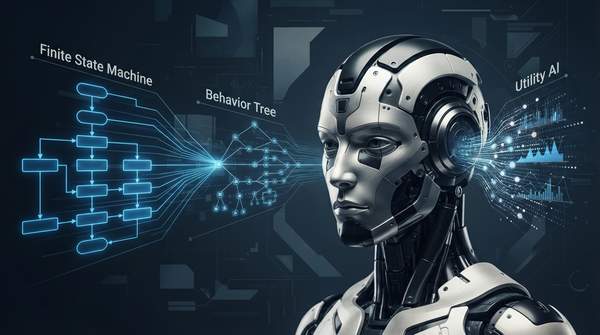
For simple, predictable NPCs, a finite state machine is usually the right call—it is straightforward to build and easy to reason about. For NPCs performing complex, multi-step work where you need to reuse logic across characters, behavior trees are the more scalable choice. And when your NPCs face situations too varied and murky for either pattern, utility AI lets them score their options and pick the best action in context. That is the short version of the decision; the rest of this article explains why, and gives you a framework for applying it to your own project.
Introduction to NPC AI Architectures
Game AI is a distinct discipline from the generative models that dominate headlines. As the developer behind the Queen of Squiggles game development guides puts it, game AI is one of the more "smoke and mirrors" kinds of intelligence—and that sleight of hand is exactly where games development thrives. You are not building a mind; you are building decision-making logic that produces believable behavior within a CPU budget.
Three architectural patterns dominate NPC decision-making. Finite state machines model behavior as a set of named states with transitions between them. Behavior trees organize behavior into a hierarchical structure of reusable nodes. Utility AI scores every available action each decision tick and selects the highest-scoring one. None is universally superior—each maps to a different level of behavior complexity, and the goal is always to serve gameplay rather than showcase technical prowess.