Confidential computing protects data while it is being processed—the one state that encryption at rest and in transit cannot cover—by running workloads inside hardware-isolated Trusted Execution Environments (TEEs) whose memory even the host hypervisor and cloud operator cannot read. For a cloud architect, the two decisions that matter most are which architectural model of TEE to adopt and how the cryptographic process of remote attestation establishes trust with a secret provider. This article explains both: the trade-offs between application-level enclaves and VM-level isolation, and a step-by-step model of how a TEE proves its integrity before receiving decryption keys.
Understanding Confidential Computing and Trusted Execution Environments
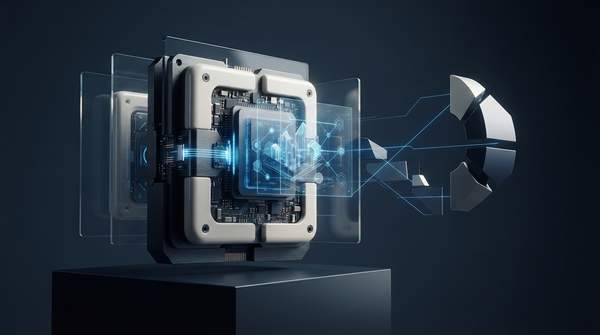
A TEE is a hardware-enforced boundary within a CPU that executes code and processes data with protections that extend below the software stack. Application-layer controls such as input validation, access management, and output filtering operate within the software itself, which is precisely why they cannot defend against a compromised hypervisor, host OS, or malicious insider with physical access; a TEE moves the trust boundary into the processor. Fortanix's technical FAQ distinguishes TEEs from these software approaches on exactly this basis: the isolation is enforced by silicon, not by code that an attacker with privileged access could subvert.
On the CPU side, key architectures include Intel Trust Domain Extensions (TDX), which provides VM-level confidential computing on Intel Xeon Scalable processors; AMD Secure Encrypted Virtualization–Secure Nested Paging (SEV-SNP), offering similar VM-level isolation on AMD EPYC processors; and Intel Software Guard Extensions (SGX), an earlier Intel implementation that operates at the application enclave level. GPU-level TEE support matters for AI workloads because inference runs on GPUs; NVIDIA's Hopper (H100, H200) and Blackwell (B200, RTX Pro 6000) GPUs ship with native confidential computing support, though GPU TEEs are outside this article's focus.
Architectural Models of TEEs: Application-Level vs. VM-Level
The fundamental architectural split is the scope of what gets isolated. Application-level TEEs such as Intel SGX isolate specific application code and data within an enclave—a protected memory region carved out for a single process. This offers fine-grained protection: only the enclave's contents are shielded, and the surrounding application, OS, and hypervisor remain outside the trust boundary. The cost is integration effort, since the application must be partitioned so that the sensitive code and data fit inside the enclave.
VM-level TEEs—AMD SEV-SNP and Intel TDX being the leading examples—encrypt the memory of an entire virtual machine, protecting its state from the hypervisor. The protection extends to the whole VM, including the guest OS and all applications within it, which means unmodified applications can often run inside a confidential VM with little or no code change. IBM Secure Execution and RISC-V Keystone also offer VM-level or similar isolation. The trade-off is a larger trusted computing base: the guest OS is now inside the boundary, whereas an enclave keeps the boundary tight around a single process.
The Cloud Security Alliance cautions that do-it-yourself enclave implementation can be complex for enterprise applications, requiring effort and expertise to integrate multiple open-source components, attestation frameworks, and cryptographic and kernel mechanisms; third-party solutions that abstract across different confidential computing environments can eliminate this complexity. That integration burden is often the deciding factor between the two models.
Remote Attestation Flow for Confidential Workloads
Isolation alone is not enough: a remote party holding secrets must verify that the TEE is genuine and running expected code before releasing anything. Intel's TDX DCAP documentation defines attestation as a process used by software to demonstrate to a remote party that the software has been properly instantiated on a platform. The sequence below traces how that proof is produced and consumed.
- The workload requests an attestation report. The TEE-protected workload—the attester—initiates the flow to prove its identity and integrity to a remote party. In Intel TDX, generation can be triggered on boot of the Trust Domain, by an external party sending a request, or by other signals.
- The TD reaches out to the hardware for a TD Report. Per Intel's TDX Enabling Guide, the flow starts with the TD requesting a TD Report from the TDX hardware. This report contains measurements of the TD and other security-critical attributes.
- The hardware generates cryptographic evidence. The CPU produces a signed measurement of its current state and configuration. For Intel TDX, the TD Report contains measurements such as the TDX module's security version number and measurement registers—hashes computed over the loaded code and configuration, where the order of hashed fields matters to the resulting digest.
- Quoting infrastructure signs the evidence into a quote. A quoting library—Intel's DCAP Quoting Library in the TDX case—takes the hardware-generated report and signs it, producing a verifiable artifact called a quote. Intel defines the TD Quote as a cryptographic attestation, or secure proof, generated by TDX hardware to prove the authenticity and state of a Trust Domain; quote generation is always done on the TDX hardware itself.
- The workload sends the quote to the verifier. The secret provider—the verifier—receives the quote over an untrusted network.
- The verifier validates the quote against policy. The verifier checks the quote against the manufacturer's certificates and a predefined policy. The Confidential Computing Consortium describes configuring key management infrastructure to evaluate attestation evidence against a policy controlled by the party deemed the trustworthy owner of the TEE, and to refuse the key unless the evidence shows compliance.
- Secrets are released on success. A key management system that enforces attestation-gated release provides decryption keys only after verification succeeds. If any component is unexpected—wrong firmware version, modified code, different hardware—the verification fails and the data is not released.
Cryptographic Artifacts and Verification in Attestation
The artifacts exchanged in this flow are what make the proof cryptographic rather than reputational. The TD Report is the raw hardware-generated evidence: a set of measurements—hashes over the TEE's code and configuration—produced by the CPU itself, so it cannot be forged by the guest or the hypervisor. The quote is that evidence transformed into a transportable, signed statement by the quoting infrastructure, which holds attestation keys whose certificates chain back to the manufacturer.
Verification has two variants in Intel's DCAP design. In the standard variant, the verifier runs the Intel TDX Quote Verification Library directly against the quote. In the alternative, the verifier uses an SGX-enabled environment: the verifier's application contains an SGX enclave that verifies the quote-verification results, passing information about its own enclave alongside the TD Quote to a usage verification library that links the same QVL. This lets the verifier receive cryptographically verified verification results rather than trusting its own host.
One caveat deserves emphasis. A 2024 research paper on confidential computing transparency notes that attestation alone cannot guarantee the absence of vulnerabilities or backdoors; it proves the environment matches an expected, measured state, not that the state itself is free of flaws. Attestation verifies integrity against policy—it is not a proof of security.
Establishing Trust: From Attestation to Secret Provisioning
The end state of the flow is conditional trust. The key management system acts as the gatekeeper: it evaluates the quote against policy, and only a passing evaluation unlocks the decryption key. This is what makes the model powerful for SaaS—the secret provider never has to trust the cloud operator, only the hardware manufacturer's certification chain and its own policy. The Consortium's example of secure key release illustrates the pattern: attestation evidence generated at boot is evaluated by the key management infrastructure, which refuses the disk-encryption key unless the machine is in compliance.
For architects, the practical consequence is that secret provisioning should be designed as attestation-gated from the start: keys, credentials, and customer data should be released only after a validated quote, never pre-provisioned into the environment.
Making Informed Decisions on TEE Architectures
Cloud architects and security engineers should evaluate TEE architectural models—application-level versus VM-level—and the specifics of their attestation processes based on the required isolation, ease of integration with existing applications, and the scope of the trusted computing base. Application-level enclaves like Intel SGX minimize the trusted computing base but demand code partitioning; VM-level TEEs like AMD SEV-SNP and Intel TDX lift unmodified workloads into a confidential VM at the cost of trusting the guest OS. The measurable indicator of a successful deployment is attestation-gated secret release working end to end: logs showing successful quote validation and key provisioning. If a wrong firmware version or modified code causes verification to fail and the key is withheld, the architecture is doing its job.
Sources
- Why is Attestation Required for Confidential Computing? – Confidential Computing Consortium — Confidentialcomputing
- Trusted Execution Environments — Fortanix
- Confidential Computing: Simplifying Trust — Cloudsecurityalliance
- Download
- Infrastructure Setup - Intel® TDX Enabling Guide — CC Enabling