X Square Robot, a physical AI powerhouse, has completed four consecutive financing rounds, rocketing its valuation past $2.8 billion, according to MarketScale. The massive investment confirms surging market confidence in physical AI's power to redefine industrial automation and robotics by 2026. It's a clear move towards intelligent systems that adapt and learn, leaving fixed functions behind.
Industrial automation once meant rigid, hardware-specific solutions. Now, physical AI delivers flexible, software-defined systems that adapt and learn across diverse tasks. This creates a fundamental tension: established proprietary hardware clashes with the urgent demand for adaptable, intelligent software.
Companies ignoring software-centric, AI-powered automation risk being outmaneuvered by agile, efficient competitors. The shift prioritizes adaptable intelligence over specialized machinery, reshaping the industrial sector's competitive landscape.
X Square Robot's $2.8 billion valuation, fueled by four financing rounds, positions it as a leader in industrial automation. The financial backing isn't just an investment; it's a declaration that adaptable, software-defined intelligence is the future. Investors clearly believe physical AI will unlock unprecedented efficiency, making traditional hardware-first approaches obsolete. The market is decisively betting on physical AI's software-centric flexibility to drive the next wave of industrial transformation.
The Shift to Software-Defined Automation
Intrinsic, Google's AI robotics company, unveiled the Intrinsic Intelligence Cell. The modular robot workcell prioritizes software over hardware, a radical departure from traditional automation where hardware dictated capabilities, according to Robotics & Automation News. Powered by IntrinsicOS, the Intelligence Cell serves as a crucial reference architecture for manufacturers, machine builders, and systems integrators. The Intelligence Cell isn't just a product; it's a blueprint for the software-defined factory, empowering diverse industries to adopt flexible automation.
Hirebotics launched the Cobot Painter on June 25. Built on FANUC's CRX-10iA/L Paint hardware, its Beacon Platform requires no code for configuration, MarketScale reports. The no-code approach democratizes automation, allowing non-specialists to configure complex robot systems. Advanced robotics becomes accessible to a much broader user base, far beyond traditional programming experts. The fundamental shift empowers machines to be adaptable and easy to deploy, shattering the old model of rigid, specialized hardware.
Real-World Deployments and Expanding Capabilities
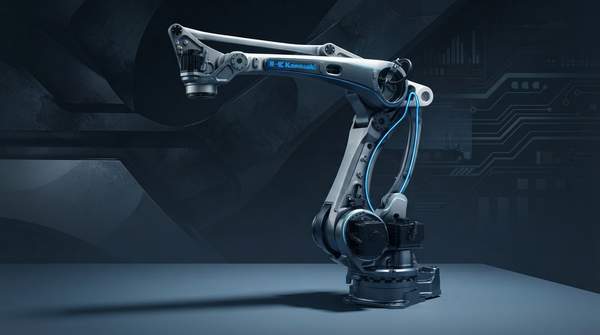
Real-world deployments are pushing physical AI into critical operations. Ambi Robotics and Pickle Robot achieved the first commercial integration of their systems into a single automated inbound logistics workflow, according to MarketScale. The combined system handles everything from truck unloading to palletizing, entirely without human intervention. Simultaneously, Kawasaki Robotics and Dexterity expanded their collaboration around the RL030N, an 8-degree-of-freedom robot arm platform, MarketScale stated. The two developments, though different, reveal a dual push: one towards seamless, end-to-end autonomous workflows, and another towards highly specialized hardware capable of complex, precise movements. The Ambi/Pickle integration proves that fully autonomous, complex workflows are no longer theoretical; they are being realized in critical industrial applications. Meanwhile, the Kawasaki/Dexterity partnership confirms that advanced hardware, when paired with intelligent software, dramatically expands the scope of tasks robots can perform autonomously.
Interoperability and Strategic Partnerships Define the Leaders
True leadership in physical AI hinges on interoperability and strategic partnerships. Intrinsic, for instance, champions compatibility across diverse hardware platforms instead of building a closed ecosystem, Robotics & Automation News reports. The approach accelerates broader adoption by ensuring robots from different brands can work together seamlessly. Nvidia mirrors this philosophy, partnering with industry giants like Rockwell, Fanuc, and ABB. Their goal: integrate simulation technology with robotics tools, fostering common standards and shared development environments, according to Manufacturing Dive. Together, Intrinsic and Nvidia are forging an open, collaborative future for robotics, a stark contrast to the siloed systems of the past.
Yet, a hybrid reality persists. While Intrinsic and Nvidia push open platforms, companies like Kawasaki Robotics and Hirebotics still pursue collaborations centered on specific, proprietary robot arm platforms. The situation creates a landscape where hardware-agnostic software remains an aspiration, even as practical development often requires hardware-specific integrations. Businesses ignoring software-defined, interoperable AI platforms risk entrapment in rigid, expensive hardware ecosystems. The systems simply cannot adapt to rapidly evolving industrial demands. The future of physical AI clearly favors collaborative ecosystems and open standards, rewarding companies that prioritize integration over proprietary lock-in.
The Next Frontier: Edge AI and Advanced Reasoning
The next frontier for physical AI is edge intelligence and advanced reasoning. DEEPX and Sixfab launched the DEEPX AI HAT, an AI acceleration module for Raspberry Pi hardware, MarketScale reports. The module eliminates cloud dependency for real-time inference in robotics and smart automation, allowing industrial systems to process complex AI models directly on-device, drastically reducing latency. Meanwhile, engineers are leveraging large language models (LLMs) like Claude via an agent interface (MCP). They use LLMs to pull technical specifications and RFQs, enabling smarter rigging and control of simulation tools, according to Manufacturing Dive. Together, the advancements mean real-time, complex decision-making is moving directly to the factory floor, making automation faster and smarter than ever.
The DEEPX AI HAT's ability to eliminate cloud dependency for real-time inference is a game-changer. It defies the trend of pushing advanced AI to centralized cloud services. The ability to eliminate cloud dependency marks a critical shift towards on-device intelligence, vital for latency-sensitive industrial applications where immediate decisions are paramount. Edge AI solutions like the DEEPX AI HAT prove that real-time, critical automation is shedding cloud dependency. Businesses must now rethink their infrastructure, prioritizing on-device intelligence for robust, low-latency operations. Edge computing, combined with advanced AI models like LLMs, is now essential for enabling real-time, intelligent decision-making directly within physical systems, boosting autonomy and cutting latency.
By late 2026, manufacturers who fail to embrace adaptable, software-defined physical AI platforms will likely find themselves at a significant competitive disadvantage against more agile, AI-powered operations.