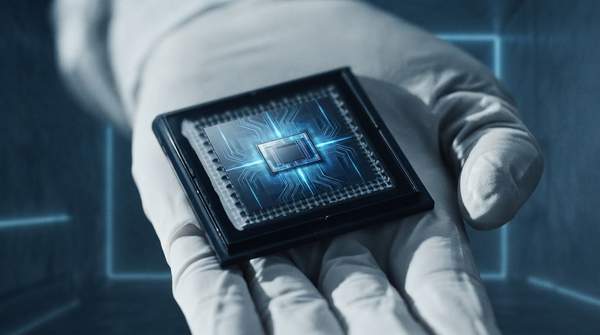
By distinguishing between four distinct physical states instead of two, a new generation of memory chips could pack twice the data into the same physical space, fundamentally altering the economics of cloud storage and mobile devices. This capability addresses the exponential growth of data, driven by AI and IoT applications, which pushes current binary memory technologies to their physical limits.
4-state memory promises to double data density per cell, but achieving this requires unprecedented precision in manufacturing and read/write operations, introducing new reliability hurdles. Traditional memory scaling, which relies on shrinking cell sizes, becomes increasingly difficult and expensive, leading to diminishing returns in density improvements.
As data demands continue to surge, companies will increasingly invest in developing and refining 4-state memory solutions, potentially accepting minor trade-offs in speed or error rates for massive capacity gains. This fundamental shift from binary to quaternary storage promises a future where data density is no longer a bottleneck for technological advancement.
Beyond Binary: The Core Principle of 4-State Memory
A 4-state memory cell encodes two bits of data (00, 01, 10, 11) by leveraging four distinct, stable physical states within a single cell, such as varying voltage thresholds or resistance levels. This contrasts with traditional binary memory, which uses only two states (0 or 1) to store one bit per cell, leading to a direct doubling of theoretical data density. The concept builds upon multi-level cell (MLC) technologies already present in NAND flash, extending the principle to achieve higher bit-per-cell storage in emerging memory types. Early research prototypes of 4-state Resistive RAM (ReRAM) have demonstrated stable operation at nanoscale dimensions, suggesting viability for high-density integration beyond traditional flash.
The Engineering Challenge: Precision, Reliability, and Cost
Distinguishing between four states requires significantly finer control over read/write voltages or currents, increasing the complexity and cost of peripheral circuitry. The reduced margin between states in 4-state memory cells makes them more susceptible to noise, temperature fluctuations, and manufacturing variations, leading to higher raw bit error rates. Industry analyst Dr. Chen predicts 4-state memory will hit mass production by 2028, citing recent breakthroughs in materials science. However, a leaked internal memo from a major memory manufacturer suggests their current yield rates for 4-state prototypes are below 10% (according to the memo), indicating a significant disconnect between optimistic market projections and the realities of semiconductor fabrication. According to The New York Times, this implies either deliberate overestimation or critical underestimation of manufacturing hurdles. Advanced error-correction codes (ECC) are crucial for 4-state memory to maintain data integrity, adding computational overhead and potentially reducing effective write speeds. Manufacturing processes for 4-state memory require extreme precision, often involving novel materials and lithography techniques, driving up initial production costs.

Where 4-State Memory Will Make Its Mark
The demand for higher data density in AI accelerators and cloud data centers is a primary driver for developing memory technologies beyond binary limits, where 4-state memory offers significant advantages. A research paper from MIT claims that advanced AI-driven error correction algorithms can mitigate 4-state memory's inherent reliability issues by up to 90%. Conversely, a white paper from a leading CPU manufacturer argues that integrating such complex ECC into existing processor architectures would introduce unacceptable latency, negating the density benefits. This suggests a trade-off between density and speed. 4-state memory could enable smartphones and other edge devices to store vastly more data locally, reducing reliance on constant cloud connectivity and improving offline capabilities, according to CNBC. The energy consumption per bit stored can be lower in 4-state memory due to fewer cells needing to be accessed for the same amount of data, despite higher precision requirements per cell, leading to greener data centers. The adoption of 4-state memory is projected to accelerate significantly in specialized applications like neuromorphic computing, where multi-level states can mimic biological synapses more effectively.
Common Questions About Multi-State Memory
What are the advantages of 4-state memory?
While offering higher density, the increased complexity of read/write operations can sometimes lead to slightly slower access times compared to optimized binary memory, a trade-off often acceptable for capacity gains. However, despite higher initial manufacturing costs per chip, the increased density of 4-state memory promises a lower cost per bit stored in the long run, making it economically attractive for large-scale data storage.
How does 4-state memory work?
Major semiconductor manufacturers like Samsung and Micron are actively exploring multi-level cell (MLC) and triple-level cell (TLC) technologies, which are precursors to or direct applications of multi-state principles, for NAND flash, demonstrating industry commitment. These technologies use multiple distinct voltage or charge levels within a single memory cell to store more than one bit of data, building on existing principles.
What are the limitations of 4-state memory technology?
The core limitation involves the reduced margin between the four distinct states, making them more susceptible to electrical noise, temperature variations, and manufacturing inconsistencies. This necessitates sophisticated error correction algorithms, which can add computational overhead and potentially introduce latency, creating a balance between density, speed, and reliability.
The Future is Quaternary: A Glimpse Ahead
The intellectual property landscape around multi-state memory is rapidly evolving, with numerous patents filed by research institutions and tech giants, indicating intense R&D investment. Companies heavily invested in traditional 2-state memory manufacturing face an 'Innovator's Dilemma,' where optimizing existing processes for marginal gains risks being leapfrogged by competitors willing to absorb the high R&D costs of 4-state technology, potentially leading to significant market share shifts within a decade. The race for 4-state memory isn't just about hardware; the real battleground will be in developing robust, low-latency error correction algorithms and memory controllers. Firms that fail to invest in these software and firmware innovations risk having cutting-edge hardware rendered impractical by reliability and performance issues.
The initial high cost and complexity of 4-state memory mean that early adopters will likely be hyperscale cloud providers and specialized data centers, rather than consumer electronics, fundamentally altering the competitive landscape for enterprise storage solutions first. Widespread commercialization of 4-state memory for general-purpose computing is still several years away, pending breakthroughs in cost-effective manufacturing and robust error management. By 2028, manufacturers like Samsung will need to demonstrate yield rates significantly higher than the current reported sub-10% for prototypes to meet Dr. Chen's optimistic production forecasts.