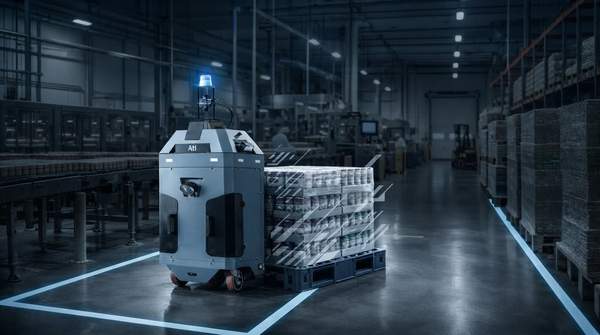
After a sluggish start to the year, North American companies ordered 8,940 robots valued at $622 million in the second quarter of 2026, marking a 21.3% revenue jump that masked a deep contraction in automotive spending. Overall robot orders saw a strong rebound in Q2 2026, but this growth was entirely fueled by non-automotive sectors, while automotive OEM investment in automation continued its steep decline. The North American robotics market appears to be undergoing a significant structural shift, with future growth increasingly dependent on the sustained expansion of automation into new and varied industries rather than its historical automotive anchor.
First Half 2026: A Resilient, Shifting Market
- First-half 2026 robot orders reached 17,995 units valued at $1.166 billion, a 2.0% increase in units and 6.6% increase in value over the first half of 2025, according to Robotics Tomorrow.
Despite quarterly fluctuations, the first-half performance reveals a market undergoing significant internal shifts. The modest 6.6% value increase for the first half of 2026, even with a strong Q2 rebound, confirms this is not a broad-based boom. Instead, it's a selective recovery, propelled by specific non-automotive segments, demanding targeted strategies from automation providers.
The New Drivers: Non-Automotive Sectors Take the Lead
Non-automotive customers accounted for a commanding 56% of robot units ordered in Q2 2026, as reported by Supply Chain Digest, starkly contrasting with the automotive sector, where OEM robot orders plummeted 25% in the first half of 2026 compared to the first half of 2025. A dramatic divergence confirms a significant rebalancing of the North American robotics market, with diversified industries now leading automation adoption. Companies heavily reliant on automotive sales must urgently diversify their client base. The sector's deep and sustained cutbacks cement a long-term shift away from traditional heavy capital expenditure in robotics.
Q1's Drag: A Sluggish Start to the Year
In Q1 2026, North American companies ordered 9,055 robots worth $543 million, according to The Robot Report. Q1 2026 orders represented a 0.1% decrease in orders and a 6.4% revenue decline compared to Q1 2025, as reported by Automation Magazine. The automotive OEM sector bore the brunt, with robot orders plummeting 35.1% in units and 48.2% in revenue during that quarter. The sharp contraction, heavily influenced by automotive spending, exposed the market's recent volatility, making the subsequent Q2 rebound even more critical. Interestingly, despite the overall negative trend, the automotive sector's rate of decline significantly decelerated in Q2 2026. Its first-half unit decline of 25% was a marked improvement over the Q1 unit decline of 35.1%, hinting at a potential moderation in the sector's automation cutbacks.
Looking Ahead: Diversification as the Path to Growth
The sustained growth in non-automotive sectors clearly positions the future health of the North American robotics market on its ability to penetrate and serve a broader array of industries, moving away from reliance on a single dominant sector. The significant 21.3% revenue growth outpacing 4.3% unit growth in Q2 2026 points to a market pivot towards higher-value, more complex robotic solutions. The shift compels integrators and manufacturers to adapt their offerings or risk being left behind by evolving industrial needs.
By the end of 2026, robot manufacturer Automation Solutions Inc., for example, will likely need to shift at least 30% of its sales strategy towards logistics and food processing applications. The adjustment is necessary to capitalize on the sustained demand from these new growth areas.
If non-automotive sectors continue their robust expansion and automotive spending stabilizes, the North American robotics market is likely to see sustained, albeit structurally different, growth through the latter half of 2026.