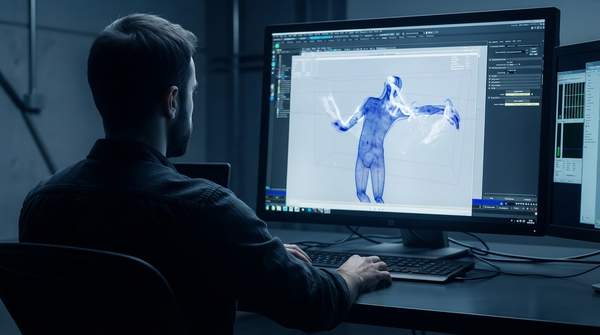
Game engine developers face a critical decision when implementing real-time rendering: whether to adopt hybrid ray tracing or full path tracing. Both approaches leverage ray tracing to enhance visual fidelity, but they differ significantly in their architectural patterns, performance characteristics, visual output, and development complexity. Understanding these trade-offs is essential for making informed design choices that align with a project's visual goals and technical constraints.
Introduction to Real-Time Ray Tracing in Game Engines
Real-time ray tracing represents a significant advancement in computer graphics, moving beyond traditional rasterization to simulate light more accurately. Rasterization, a method used for decades in games, draws 3D objects onto a 2D screen by mapping them via transformation matrices and determining pixel colors based on mesh information and scene lighting. While fast enough for real-time interactive applications, rasterization struggles with effects that depend on bounced light, such as true reflections, translucency, and ambient occlusion, often relying on "clever tricks and compromises" to achieve acceptable results, according to Unreal Engine documentation.
Historically, ray tracing was reserved for offline rendering due to its computational intensity, often requiring hours or days to render high-quality images or sequences for film and architectural visualization, as noted by Epic Games Developer documentation. However, advancements in hardware and software have made real-time ray tracing viable for interactive experiences and games.
Hybrid Ray Tracing: Integrating with Rasterization
Hybrid ray tracing combines the speed of traditional rasterization with the visual accuracy of ray tracing. This architectural pattern uses rasterization for primary visibility—determining which surfaces are visible to the camera—and then selectively applies ray tracing for specific secondary effects that benefit most from accurate light simulation. For instance, NVIDIA's technical blog highlights how hybrid systems integrate GPU ray tracing with rasterization for real-time applications, citing the Frostbite game engine's use of such a system for rapid global illumination previews. This approach allows developers to achieve enhanced realism for effects like reflections, shadows, and global illumination without the prohibitive performance cost of tracing every light path. The complexity in development arises from effectively combining these two distinct rendering paradigms and managing the data flow between rasterization and ray tracing passes.
Real-Time Full Path Tracing: Simulating Light for Fidelity
Real-time full path tracing represents a more comprehensive approach to light simulation, aiming for physically correct global illumination, reflections, and refractions. This rendering mode, as described in Unreal Engine documentation, is progressive and hardware-accelerated, designed to mitigate the compromises often found in real-time features by providing "physically correct and compromise-free" rendering. Path tracing extends the basic ray tracing approach by using Monte Carlo integration to solve the rendering equation, tracing multiple randomly generated rays at each intersection point instead of a single reflected ray.
This method simulates both direct and indirect illumination, capturing complex light interactions like global illumination, which involves light reflections from various surfaces in a scene, according to an IEEE Xplore paper. While historically inefficient for real-time applications due to the recursive nature and high number of rays, modern implementations leverage optimizations like neural denoising and frame generation, such as NVIDIA DLSS, to achieve real-time performance, as seen in Capcom's RE ENGINE for games like PRAGMATA and Resident Evil Requiem.
Qualitative Comparison: Visual Fidelity and Realism
When comparing visual fidelity, full path tracing generally surpasses hybrid ray tracing. Full path tracing's core principle is to simulate light transport comprehensively, leading to highly realistic and physically accurate lighting. This includes deeper shadows, more precise reflections, and superior global illumination, as noted in Unreal Engine documentation regarding its Path Tracer. Materials seen in reflections and refractions are rendered without limitations, incorporating global illumination and path-traced shadows. Hybrid ray tracing, while offering significant improvements over pure rasterization for specific effects like reflections and shadows, may not fully capture the complexity of global illumination across an entire scene. Its fidelity is often dependent on the specific effects chosen for ray tracing and how well they integrate with the rasterized base, as highlighted by NVIDIA's discussion of hybrid rendering systems.
Performance Characteristics and Optimization Strategies
Performance is a key differentiator between the two approaches. Hybrid ray tracing is generally more performant for real-time applications because it offloads primary visibility to rasterization and selectively applies ray tracing for secondary effects. This balance allows it to achieve real-time results, though it still requires powerful GPUs, as demonstrated by NVIDIA's early real-time ray tracing demos in Unreal Engine 4.22. Full path tracing, conversely, is significantly more computationally demanding due to its extensive light simulation, which involves tracing numerous light bounces. To achieve real-time performance, full path tracing relies heavily on advanced optimization techniques. These include neural denoising solutions, such as NVIDIA DLSS, and frame generation technologies, which are crucial for making the high computational cost manageable for interactive experiences, as seen in Capcom's work with RE ENGINE and NVIDIA RTX Kit.
Development Complexity and Implementation Considerations
The development complexity for game engine implementation also varies. Hybrid ray tracing involves integrating ray tracing components into existing rasterization pipelines. This requires careful management of data flow and rendering passes to combine the two distinct rendering paradigms effectively, as discussed in NVIDIA's technical blog on hybrid approaches. Developers must decide which effects benefit most from ray tracing and how to blend them seamlessly with rasterized elements. Full path tracing, on the other hand, demands the implementation of sophisticated light transport algorithms, robust denoising solutions, and potentially the integration of neural rendering technologies. While engine-level support and toolkits, such as NVIDIA RTX Kit, can simplify some aspects of integration, a fundamental understanding of complex light simulation techniques, like Monte Carlo integration, is still necessary for developers, as an IEEE Xplore paper points out regarding path tracing's statistical solution.
Hybrid vs. Full Path Tracing: A Game Engine Comparison
| Dimension | Hybrid Ray Tracing | Full Path Tracing |
|---|---|---|
| Architectural Approach | Combines traditional rasterization for primary visibility with ray tracing for specific secondary effects like reflections, shadows, and global illumination. This approach is designed to balance visual quality with real-time performance constraints. | A progressive, hardware-accelerated rendering mode that simulates physically correct global illumination, reflection, and refraction by tracing multiple light bounces using techniques like Monte Carlo integration. It shares the underlying ray tracing architecture but aims for a more comprehensive light transport simulation. |
| Visual Fidelity | Offers superior realism for specific effects (e.g., reflections, shadows) compared to pure rasterization, but may have limitations in fully simulating complex global illumination. The fidelity is often dependent on the specific effects chosen for ray tracing and their integration. | Achieves highly realistic and physically accurate lighting, including deeper shadows, more accurate reflections, and better overall global illumination, often surpassing hybrid approaches. This high fidelity is a primary goal, mitigating disadvantages of real-time features with compromise-free rendering. |
| Performance Characteristics | More performant for real-time applications by offloading primary visibility to rasterization and selectively applying ray tracing for secondary effects. Still computationally intensive, requiring powerful GPUs, but generally less demanding than full path tracing. | Computationally more demanding due to extensive light simulation, requiring advanced optimization techniques like neural denoising (DLSS) and frame generation for real-time performance. Historically used for offline rendering due to high computational cost, but real-time implementations are emerging with significant optimization. |
| Development Complexity | Involves integrating ray tracing components into existing rasterization pipelines, requiring careful management of data flow and rendering passes. The complexity arises from combining two distinct rendering paradigms effectively. | Requires implementing sophisticated light transport algorithms, denoising solutions, and potentially leveraging neural rendering technologies for real-time performance. Engine-level support and toolkits (e.g., NVIDIA RTX Kit) can simplify integration, but fundamental understanding remains complex. |
| Typical Use Cases | Mainstream games and interactive applications where balancing high visual quality with consistent real-time frame rates is crucial. | High-fidelity cinematic experiences, architectural visualization, and games prioritizing ultimate photorealism, often leveraging advanced hardware and upscaling technologies. |
Making an Informed Decision for Your Game Engine
Game engine developers should choose between hybrid ray tracing and full path tracing based on their project's specific priorities for visual fidelity, real-time performance, and available development resources. Hybrid ray tracing offers a practical balance, enhancing specific visual effects while maintaining real-time performance by integrating with established rasterization pipelines. Full path tracing, while more computationally intensive and complex to implement, delivers unparalleled visual fidelity and physically accurate lighting. The choice is reflected in the target platform's hardware capabilities, the desired level of photorealism, and the complexity of the lighting and reflection systems required by the game's artistic vision.
Sources
- Unrealengine
- Ray Tracing and Path Tracing Features in Unreal Engine | Unreal Engine 5.8 Documentation — Epic Games Developer
- Hybrid Approaches and Systems: Part VI of Ray Tracing Gems — NVIDIA Technical Blog
- Path Tracer in Unreal Engine | Unreal Engine 5.8 Documentation — Epic Games Developer
- IEEE Xplore Full-Text PDF: — Ieeexplore
- Q&A: How Capcom Brought Path Tracing to RE ENGINE Across PRAGMATA and Resident Evil Requiem — NVIDIA Technical Blog